
Theater Workshop
Afterwards my cousin dropped us off at a theater workshop by my friend Imran at the Institute of Performing Arts.


After some work on background paintings we head over for a delicious brunch at my aunt’s place. She showed us several beautiful oil paintings she had made. One was a painting of the Alhamra Art’s Council building which she had painted on location. It was really great to see.Afterwards my cousin dropped us off at a theater workshop by my friend Imran at the Institute of Performing Arts. It was fun to go through the exercises he had put together to get us thinking about various aspects of theater such as telling a story in words, then with facial expressions and body language. We also did a mirror exercise, where one person had to basically mirror the actions of another. There were some voice and breathing exercises and in the end we split into two groups of 6 and put on small, improvised plays.From there we head back to Mall Rd. We grabbed some egg and potato parathas at a little dhaba, before heading to Chaman for their amazing ice cream. I would say that counts as a pretty good day.

Magic Lantern
In addition to that, I am continuing to experiment with shooting as the camera normally records, and also using Magic Lantern to shoot in raw format.
 The night before I shot some test footage. I have a lot of preparing yet to do, but it was good to see the background with a puppet on camera with some lighting. Each test, I try a few more things and I get a bit closer to being ready to shoot. This time I tried out some moving shots with a slider and that was fun. It is challenging to rack focus and move the camera at the same time.In addition to that, I am continuing to experiment with shooting as the camera normally records, and also using Magic Lantern to shoot in raw format. It is essentially a very cool hack for Canon cameras and there are a few steps involved in the process, but potentially, it can allow for more freedom adjusting the final look, in terms of color afterwards. There are several pieces of software to help with different stages of the process. Essentially, you are pushing the camera to do something it can do, but the on board software does not give access to. So there are these fantastic programmers, reverse engineering the cameras to expose more features. This is quite incredible, but you have to test each step and decide what the reliable limits are as far as shooting settings. It’s good to test these options now and make these kinds of decisions or mistakes during this time. I took the footage into Davinci Resolve Light and started following a few tutorials to begin getting into that. It takes a lot to do all of this, but the knowledge that comes out of each step helps a great deal.In the evening, the wife and I walked over to a pizza place, then wandered through the crazy traffic along mall road to a book shop. Simple pleasures. Afterwards, we hopped on a rickshaw and head back home.

A process in place
I’m glad we have figured out our main sources for cloth and the workflow for creating these backgrounds. That is a huge bit of progress this week.


I’m working on a bunch of desert backgrounds for “Risalo”. I paint them in flat colors in an app called Procreate. It’s very intuitive and I can paint with my finger on the iPad. One of my favorite things about this, is that I showed Umar the basics and he was up and running in no time as well. This lets me work on a design, create a copy and let him make any changes he feels like and then pick up and add some more and go back and forth until we are satisfied. I really enjoy the conversation around shapes and color choices that helps us to get where we want.Umar finished the first background and I think it turned out beautifully. We selected every bit of fabric for its color and texture. Each piece was meticulously cut, then roughly stitched to place them and then finely stitched by hand with care given to keeping the flow of each curve to achieve what we worked out in the concept painting. I feel very grateful that he is putting a lot of love and care into each bit, as I do. What more could one ask of an artistic collaboration.We even got the second background started. It’s time to look for some additional colors of cloth that are needed. I’ll try and finish up some more designs and pick up cloth for them as well. Sunday is the day to get cloth from the Landa Bazaar. We picked up a lot of interesting pieces there. In addition, our friend Imran has a lot of bits of cloth or old clothes that have helped us a great deal, so I will have to stop by to check there as well. Any colors that are left at that point can be hunted for in some of the khaddi shops we visited earlier this week. I’m glad we have figured out our main sources for cloth and the workflow for creating these backgrounds. That is a huge bit of progress this week.

Some tasks move forward, some don't
Umar is a fantastic artist. I am fortunate to have him on board to work on these beautiful cloth backgrounds. His skill set is very complimentary to my own, as in he knows how to do a lot of stuff I do not, but need.
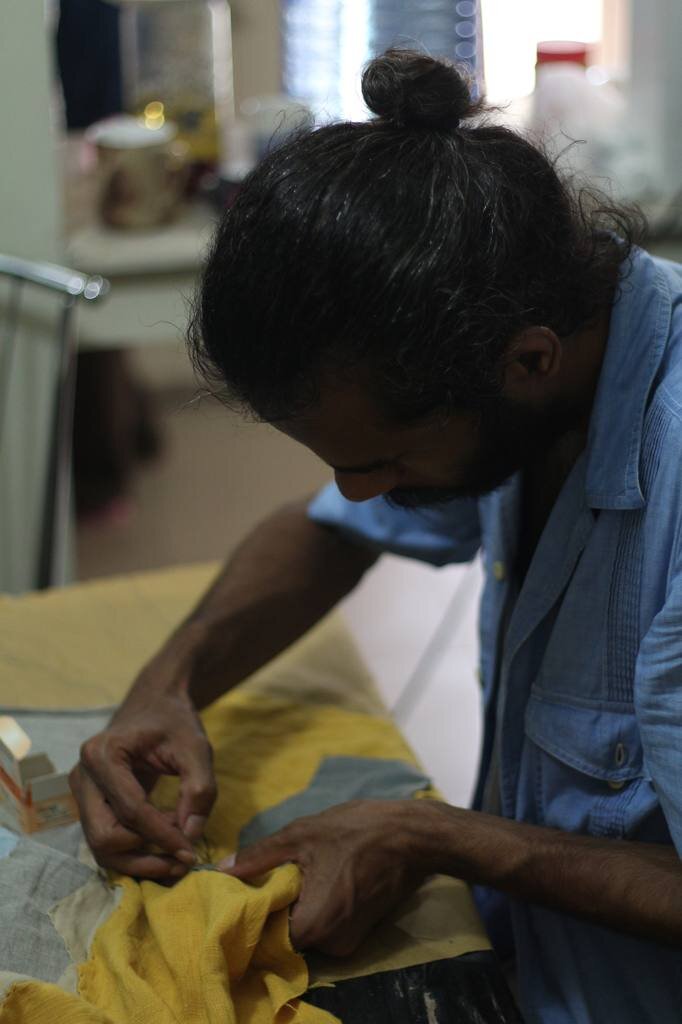


I spent the morning updating my blog. It is interesting to look back as I am posting entries about a month after the fact. Over a month ago, I was finishing music in Jamshoro. A lot has happened since then, and yet some things are right where they were, despite my best efforts.I have not been able to digitize any of the other DV tapes to work on music as I have not been able to find a source to get a DV VTR that I can digitize footage into a mac with. I am getting close, but I am not there yet.Backgrounds on the other hand are being made, after going through many steps and challenges. I have progressed on lighting and photography, though not quite ready on that end and I am more familiar with how the puppets can be manipulated. I still need to do more on that end, but things are going. I always feel like I am spinning plates.Umar is a fantastic artist. I am fortunate to have him on board to work on these beautiful cloth backgrounds. His skill set is very complimentary to my own, as in he knows how to do a lot of stuff I do not, but need.After working the rest of the day, Kristeen, Umar and I head to Panj Vera via the metro bus to grab dinner with friends. It was fun to just laugh, eat aloo and egg parathas, drink khoya khajoor, badam milk shakes and eat ice cream. Zahid once again drove us all the way back, across town to where we are staying. I have a deep appreciation for friends who go out of their way to drop us off, because it is a huge help. Besides, it was a lot of fun to talk about movies and all kinds of other silliness.

Backgrounds continue
I worked on some more designs for backgrounds. There are several ways to reuse backgrounds, so that should help cut down on the number we need.

 I worked on some more designs for backgrounds. There are several ways to reuse backgrounds, so that should help cut down on the number we need. I think I can bring down the required number from 25 to about 12. That includes combining several backgrounds that will only be seen closeup into one cloth piece.Umar dropped by around noon and continued working on the rough stitch of the pieces he cut the day before. I had made the long walk in the heat to recharge our internet and pick up vegetables. Kristeen made some lunch and all of us spent the day working on our projects.In the evening, Umar had beautifully stitched some of the sky pieces. The three of us hopped on rickshaw, then made our way through Anarkali, crossed Mall rd and made it just in time to return the useless “tailoring” scissors to the art store and pick up some large sheets of tracing paper. Umar head off to tend to other tasks, and Kristeen and I grabbed some nice food in Anarkali. It feels good to see this next stage of the project starting. It takes a lot to prepare and figure things out, so once you start to see some results, it is quite exciting. It is amazing to see Umar share his input on the design painting and then create it out of cloth. He’ll climb on the table, fix up paper and cloth with pins, then thread the whole design. This project is a ton of work, but these moments where I get to collaborate and create in mediums I have never touched before are truly special.

Backgrounds begin
I started work in the morning with Umar on background designs. We discussed and worked on the design for the first one we plan to make a bit further.


I started work in the morning with Umar on background designs. We discussed and worked on the design for the first one we plan to make a bit further. Then off we went with Kristeen to the Urdu Bazaar for brown paper to create patterns, and then to the khaddi market for some cloth pieces in the colors we were not able to find at the Landa Bazaar.We walked through the Mayo hospital to get back to Anarkali. On the way we saw a family grieving hysterically in the hospital grounds, likely at the loss of a loved one. The sounds were heart breaking and devastating.Going through Anarkali, we picked up some art supplies, including cloth cutting scissors, then went back to the hostel. I picked up some lunch and we continued working. The scissors were no good. We’ll have to find good ones and continue. This is how tasks start, in growths and spurts and then some sputters.

Landa Bazar
cloth shopping for backgrounds


We took a morning walk through the sunday bazar in Krishan Nagar, followed by a walk to Sant Nagar with breakfast at Imran’s. Umar got there and we head to Delhi gate via rickshaw. We picked up a bunch of cloth for only RS 150 (about $1.50) at Landa Bazar, then walked through Delhi Gate, through the cloth markets, then out through Bhatti gate.It was such a relief to have Umar’s help in locating different kinds of cloth. I felt like I finally had a process for finding cloth of the type we need to create the backgrounds for “Risalo”.On the way back, we walked through the side of Data Darbar, back to Imran’s. We picked up some nihari and all ate together, then walked home. It was great to have all of that support.

Chaman and Waris Nihari
Ice cream and nihari


It was another day of working on the computer at the hostel. In the evening, we grabbed some ice cream at Chaman with our friend Umar. Afterwards, we took a rickshaw into some windy roads with heavy traffic to pick up some nihari at Waris Nihari. I just had the rickshaw wait for us, because the place was a mess with traffic.

Working
I worked on designs for backgrounds. In the evening we had dinner with a friend of Kristeen’s from the Peace Festival in Chandigarh back in 2009.
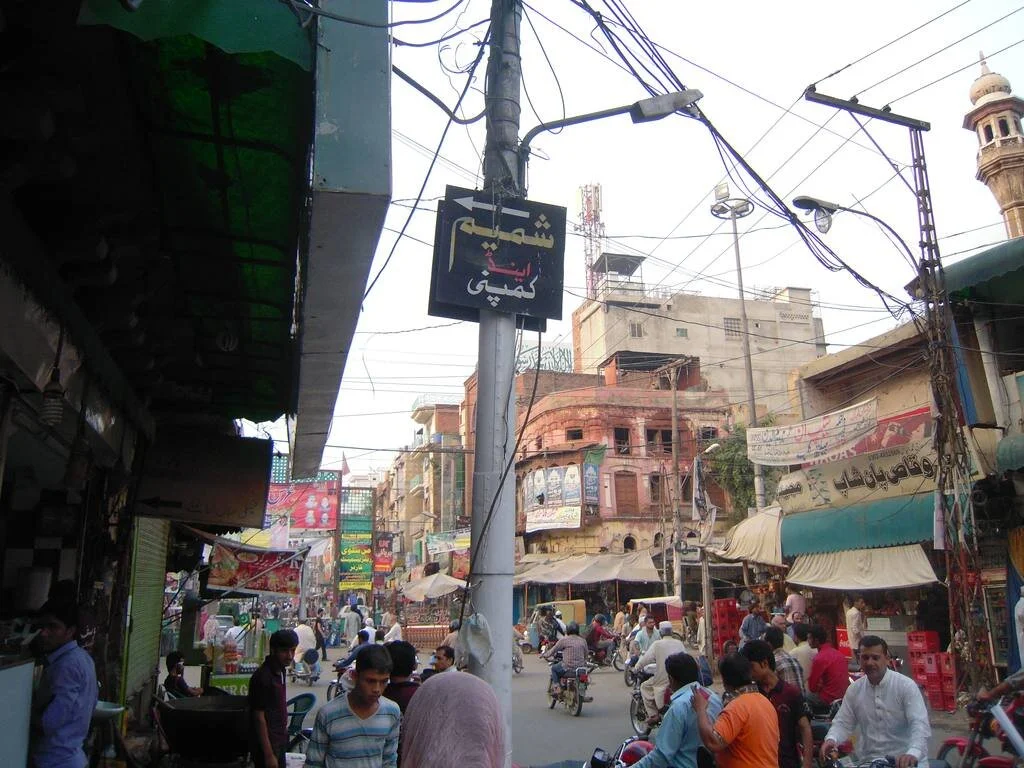


I worked on designs for backgrounds for "Risalo". In the evening we had dinner with a friend of Kristeen’s from the Peace Festival in Chandigarh back in 2009.

Watching "Moor"
 After some work in the morning, we head over to Fortress Stadium, to get away from the hustle bustle of the older parts of the city for a bit. We hopped on a rickshaw and went there. I wanted to check out a film called “Moor”, so we went to a nice movie theater in a mall to watch it there.It is really great to see the Pakistani film industry reviving. This isn’t just about making new movies, but about developing all the talent that goes into making something great. Based on my own, very grassroots efforts to create a film here, I can certainly appreciate the challenges. Though a number of these films are sponsored by local tv channels, I have no doubt that each production deals with untold numbers of challenges to reach the screen, whether funded by a local media outlet or not. It is very promising to see channels supporting films, as that is probably the only way to create a financially viable industry. The sheer number of films coming out seems to indicate that companies are making enough money to continue. I look forward to this commercial industry paving the way for a parallel cinema in the future that represents the quality of writing I see in short stories and novels in our local literature.I had seen trailers for “Moor”, directed by Jami, known for his music video work. The shots from the trailers, featuring landscapes from Balochistan were gorgeous. The composition and color was truly breathtaking. The film itself felt rather long. There were a lot of beautiful shots, and I liked the premise of the story, which was quite different than some of the other Pakistani films coming out. “Moor” seemed to try and tackle something a bit deeper and made an attempt at portraying the intersections of class and various struggles that are very much connected. The strongest scenes to me were the montage scenes, which were more poetic and similar to music videos. The rest of it had a lot of visual beauty, which is no small feat in itself, but in terms of the characters, their humanity and dimensionality, I felt that much could be done to build upon this start in the future.Things were quite dramatic, yet the dialogue and progression of the story did not seem to effectively build up to moments that created an understanding in the viewer, rather than just telling us what happened, or perhaps pushing too many stories and moments into the film without allowing them to develop in a satisfying way.Anyway, I was glad to see “Moor”, regardless. In a country where so much is falling apart, it brings me a great deal of joy to see what seems to me, a real honest effort at something better. As a filmmaker myself, I marvel at all the successfully executed parts of the film and aspire to learn and do my best in my own work. I certainly look forward to Jami’s future work. Seeing a work with so much beauty, it is easy to focus on what is lacking, but as a filmmaker, it reminds me how astonishingly difficult it is to connect on all the levels that a truly great film can. Each film is hopefully a step towards getting there.Afterwards we walked around the nice malls, ate some food and walked around a bunch more before heading back to the hostel. Ustad Anb Jogi was on his way back from Islamabad. It’s a long and grueling ride back to Hyderabad, so he stopped in to get some sleep. It was good to see him before he head out once again in the early morning to get the rest of the way home.

Nisbat, Beadon, Hall


I head out to Nisbat, Beadon and Hall road, to check out lighting gear. It takes a lot to ask questions and even more to get any real answers about anything and everything. A few hours in the heat and your day is done. My friend Ustad Anb Jogi dropped by at night on his way to Islamabad.

Light from Nisbat


After a bit of calling around, I learned that Sunday was the day that different markets sold cut piece or smaller pieces of cloth. I don’t know why the many shops I asked never offered up this information, but that is the way much of the information gathering for this project has been.That saved me a lot of needless travel in the morning. I did some small video tests with my available lighting and camera equipment. I researched some lighting options locally, thanks to help from an LED specialist I had met in Los Angeles, who is from Pakistan. He had given me the local manager of his business’ number in Karachi. I called him, mentioned his boss and he helped me right away. I sent him specs on a simple LED light I had, and he looked up the closest match. Not only that, he found a retailer with a reasonable price. Based on that, I found one here in Lahore with the same price, then went and picked it up.Afterwards, we grabbed some food at Gawal Mandi, the so called “Food Street”. A bit of walking in traffic after, followed by a rickshaw ride back and the day was done. The new light is pretty good. Of course it is missing a nut, so I need to ask about it or find a replacement nut, but it is pretty bright. I think if I can pick up one more and find some lamps for the photo bulbs I brought, I should be covered for lighting. The alternative would be to rent higher end gear, but I like these lights for being light, portable, battery operated, not prone to heating up and sufficient to light the small area needed for this puppetry film.

Lahore Museum
A visit to the Lahore Museum


I had hoped to go cloth hunting over the last few days, but it just did not happen. I remember seeing a great variety of cloth shops in Delhi Gate that seemed to be a good place to try and piece together these backgrounds.We hopped on a rickshaw and head over there just after noon. The walk through the short portion that has been renovated and freed of encroachments and sign boards is quite nice. It is a glimpse of what this place could be. The cloth shops begin a bit after Masjid Wazir Khan. There are so many varieties of cloth, but as it turned out, they are wholesalers so they do not sell the small quantities I need for my work.By that point, we were tired from the heat and the challenges of getting information. They had all the kinds of cloth I could want, but did not sell smaller pieces. We walked back out, caught a rickshaw, then head to the Lahore Museum and spent some time looking at beautiful pieces of architecture, sculpture and paintings. Afterwards, we head back and grabbed some daal and rice from the little corner stand. It was really good, as a lot of food here tends to be.After a few hours of rest and asking around some more for where I might find cloth, Imran suggested a few places with Krishan Nagar being the closest. It was less than a 1 km away, so I just walked over there. There were many cloth shops, but this time they sold patterned cloth by the suit, as in you needed to buy enough for a set of clothes. I could not get the meter and a half or so that I wanted. Well, that was the end of another day of searching. I came back and we had some dinner that we made, then rested. I have a few more leads for places to check. I need to muster up the strength to go to them tomorrow.

Anarkali and the sunday book bazar
At the end of the line of book sellers, I came across an interesting art book that I could not resist.


We took a walk through Anarkali, ate some haleem, then head over to the sunday used book bazar. The sidewalks are lined with booksellers. It is fun to see the variety of books, long out of print. I have already picked up a bunch of books on this trip, so I am trying to be very selective about getting any more. I did not plan to buy anything. It’s just fun to look at the interesting book covers and discover topics and books in Urdu and English from years ago. You get a sense for what people have been writing about.At the end of the line of book sellers, I came across an interesting art book that I could not resist. It was a book of paintings by a couple of Chinese watercolorists (Lin Yong and Su Hua), documenting their trip through Pakistan in 1978 and 1981, called “Pakistan”.Afterwards, my aunt picked us up and we head to her place for another amazing meal. I got to catch up with some cousins who very talented painters as well.

Baby goat in the window
A surprise visit


I spent the morning going over blog posts. During July, I had stopped posting all together. I kept writing, but things were so difficult while working on the music for “Risalo” that I could not bring myself to keep posting. So it was, that in mid August, I was rereading and posting blog entries from July.It is a bit difficult to read through those posts. The weight of those struggles is still here, though some distance and time has helped me push ahead. I try to focus on the great people that helped me through the process. Once again, I find myself looking at and getting to know a new set of people, connected through old friends who offer advice and assistance, without which things would be impossible.I did some research and a few sketches for the first cloth background I want to create for “Risalo”. I looked at some other examples of quilted landscapes and flat color, graphic shape landscapes for inspiration. It helps to see how others have tackled a particular challenge.A little goat was crying in the yard behind the hostel room. My wife and I saw it come up to the window. We saw it through the screen and dirty glass. She suggested that we feed it the yogurt she just made with spices in it. I reminded her that Pakistanis don’t feed goats spicy yogurt, we eat goats with spicy yogurt. I don’t know, I didn’t want the little fella to have a problem with spices. I’ve only ever fed grass to goats. The hostel doors on that side have locks on them, so I walked around and found a gate to that same yard. I opened it and the little goat followed me out. Then I was told that someone had brought it for safe keeping. A guard put it back in. I went to get some water for the little goat, but by the time I stepped back out of my room with it, the goat’s owner was taking care of it. In the evening we visited some relatives and enjoyed some delicious food.

Independence Day
I spent most of the morning resting and looking at the strings on the puppets to get a better understanding of how they work.


I spent most of the morning resting and looking at the strings on the puppets to get a better understanding of how they work. I want to try and get the basics of manipulating them down. The strings and what they control are straight forward, but the best way to wrap them around fingers for control is more challenging. There are videos my wife took of Puran Bhatt, Rajesh Gurjargour and the book on puppetry to help with this. Strings get tangled easily as well, so a lot of care must be taken in handling and putting them away.It was nice to just cook some food at home and eat. We went over to “new” Anarkali, then walked through to Lohari Gate and picked up some sweets, then head back through Anarkali and home. People are out, waving flags after the rains. We took several detours to avoid streets filled with water. The water should recede by tomorrow as it usually does.

Friends and plans on the eve of independence day
Figuring out "Risalo" related stuff and hanging with friends on the eve of independence day.


I’ve been reading more of “Kathputhli” by Nazir Ali Jairazbhoy. There are some great sections on puppet manipulation and some of the descriptions on how the strings are held and used are particularly helpful. Now I need to practice this. It takes a process to go from concept art to execution of a design in its final form in such a way that it conveys what was intended.I’m looking at the rough backgrounds that I painted for the animatic (the moving storyboards) for “Risalo”. A couple of months ago, I did some sketches to narrow down how many backgrounds I would actually need based on that. For the two main stories, Sur Sorath and Sur Sohni, there are about 26 backgrounds. I may need to narrow that down further, but that’s what I have planned at this stage. My friend, courtesy of Imran Siddiqui, Umar came over. We have met some really fun and interesting friends here. Umar, Umair and Beenish dropped by.I took Umar through the animatic, some music recordings, puppetry videos from Multan that I had put together and then the puppets themselves. We brainstormed some ideas on how to take these backgrounds sketches and turn them into something that works for the film as well as staying grounded in the world of traditional puppetry with some artistic liberties. Traditionally, the stage is set with two charpoys (cots) stood up, with their legs facing each other. A bamboo rod is set between the ropes on both charpoys. Cloth is draped above the rod to hide the puppeteer from the audience and below the bamboo to form a backdrop for the puppetry stage. Often, there is an additional cloth with windows (jaali) draped at the front of the stage, behind which the performance takes place.I removed the jaali and will likely create a more modular framework, rather than actual charpoys to suspend cloth. I don’t need to hide the puppeteers as I can simply frame the camera as needed. What I do need, is a cloth on the background and on the floor of the stage that can indicate where a particular scene takes place in the story. I want to keep it abstract and simple enough to not be distracting. Umar and I worked on some ideas and will hopefully begin work on a prototype next week. He had some really good suggestions which makes the process a lot more fun as well.During this time, we had a stream of friends join us. Imran and a coworker friend of his dropped by, as well as Raza of the Awami Artist Collective. It was actually a lot of fun to figure out how I might approach technical aspects of lighting and camera work as well as securing equipment and help for these tasks. Without this community, I would be on my own, and quite unable to navigate or access the kinds of resources that I may be able to leverage.With independence day only hours away, we head out to Anarkali and ate a delicious meal over a lot of joking around with bits of deeper conversations weaving in and out. There were so many people out. Each of these friends is doing a lot of great work and I can’t even put into words how much I appreciate all of us being able to come together, share and enjoy our time. We walked over to get some kulfi faluda and ras malai afterwards. The friends from the other side of town left after that, and Imran, Kristeen and I walked over to Hafiz Juice Corner to watch the celebration along Mall Road. Lahore is a city that loves to go out and have delicious food. There were people everywhere, enjoying time out with their families, hanging out car windows or on motorcycles, waving the Pakistani flag and just having a good time. We had some juice, laughed with some funny children and then head back to our homes.

Eat...brain..eat...brain
AAaaaaaaahhh!


We went to Mughalpura to visit relatives and ate lots of food. No, I am not related to this one.

A history of puppetry?


After a good deal of rest, we head over to NCA. Hanan sahib and Naveed sahib helped us clean our computers with a small blower. It was like a mini version of a leaf blower. To think that it took so much effort to get to this point. Partly because I was looking for the disposable kind, only to learn that that does not exist here and then it took me a while to learn what was used instead in Pakistan.With that information, a simple call and the kind folks in the multimedia department at NCA graciously helped us out. I felt like the computer is a bit better, but it is still heating up a bit on one side. I really need this machine to work through the end of shooting this film at least.It was nice to go to NCA. There were a few students around for evening classes. Security as always was notched up even higher than my previous visit and it makes me sad to see how much it has had to increase over the years.There was even a check waiting for me from my time teaching a few months ago. I needed to get the check opened in order to cash it. I went to several offices, only to be turned away. It is amazing how little some folks at these government jobs care about their work. I dress very simply so they really look at me like shit. Every little step of the way here can often be a dehumanizing process, and I think that is equally true for these office workers who then continue that vicious cycle. You need to go through someone that cares enough to try and help you get what you need done. These same people that gave me a hard time, would probably fall over themselves to cater to their personal guests.For me, when I walked into the second office I was sent to, with the paperwork required from the accounts office and asked about opening the check, the guy just looked at me. Then another guy comes into the office, grabs me by the elbow to turn me around then looks me up and down with this look of disgust, which is probably his default expression. These are the day to day steps it takes to accomplish the most minimal of things. I speak in Urdu, I dress simply. I can only imagine how much worse it is for others. To me, this is the rot at the core here. There are so many external and internal issues going on here, but at the most basic human level, the ability or willingness to do your job with a reasonable amount of care and to speak to people as human beings regardless of their perceived value to you is severely lacking in so many places.Each person asked why I was given a check, and I explained that I taught there. Then they kept repeating that I should open an account here. I explained that not being local, I could not and they past me down the line. Eventually I came back to Hanan sahib and he kindly took the paperwork and agreed to take care of it as the office workers had sent me back.In the evening, Kristeen cooked our first meal here. We picked up a bunch of vegetables, spices and fruit and a had a nice meal at home. Even making breakfast in the morning was a nice change from grabbing things outside. I relaxed and read the book on Rajasthani puppetry that she picked up for me in Delhi. It is quite fascinating to see how people have tried to piece together the history of this art form. I can only imagine how difficult it was to find anything that could be called an actual fact. Oral traditions are strong, but historical accuracy is not. Certainly not in the case of the puppeteers I met in Multan.The stories do have some common elements that leads one to believe there may be some facts amid all the legends. It seems that this form of puppetry can be traced back to the time of the Mughal Emperor Akbar. There are stories of Muslim and Hindu puppeteers. The court puppeteers were Muslim and they made their puppets from papier mache. They complained about a Bhat puppeteer who had not learned the art from any master and still dared to be a puppeteer for the general public. This fits in with the idea that specific tasks are delegated to particular groups of people and handed down through the generations.The Bhat puppeteer was called to the court, but gained the Emperor’s favor when he recited the Emperor’s geneology in poetic verse. A contest was arranged, and a puppet from the court and one from the Bhat puppeteer was suspended in a well for some time. The paper mache puppet from the court disintegrated, while the Bhat’s wooden puppet emerged more beautiful from being immersed in water.It’s a fun story, and there are bits that indicate other aspects to it as well. For example, the book mentions that puppeteers continued to pay tribute to the descendants of a Muslim family of someone who had taught them this art. This wasn’t something imposed on them, but out of respect and gratitude for sharing what was a sacred art. The way that puppeteers look at their puppets and art is with great reverence. This was true in Multan as well. Modern commercial needs have eroded away this sentiment, but I think it remains, however diminished.All examples of stories told through this puppetry seem to be about the same as what I recorded in Multan. A king’s court opens. Dignified guests enter and a multitude of trick puppets are announced and perform one by one, with short comedic skits. Sometimes the king is Akbar, or Shah Jehan or the same story revolves around Amar Singh Rathore. There were some puppets mentioned that I have not seen, but in terms of detailed storytelling, there did not seem to be any hard evidence to suggest that it was a part of past performances. People mentioned that it was, but could not be verified. People say a lot of things.

Lok Virsa and PNAC in Islamabad


We got up way too early and head to the train station. It was fun to watch the variety of people around us as we waited for our friend Sana, her sister and neighbor to arrive. They got there and we hopped on the train.It’s always pretty crazy sitting in the aisles as people squeeze past with luggage to try and figure out where they are seated. Bags and children are lifted through the windows by relatives seeing people off. You can’t get too bothered by every handbag and arm that bumps your head as people squeeze past. Once the train started, the aisles were still filled with people, but these were folks who did not have a specific seat and I think bought an open ticket. Such are the mass transport needs here that everything is packed. We were so fortunate and grateful that our friends had booked seats.Watching the landscape unfold was fun. Children wave and people in general stop to look as the train passes. You see old buildings, tents, piles of trash, long lines of traffic waiting to cross, and cleaner areas away from the cities, where large fields of crops become beautiful river landscapes with grassy hills and rocks. It was a long ride. Sana and her sister kept coming over with delicious food and tea that they had prepared with their relatives at home. We switched seats so we could chat with each other.All three of these friends are truly inspiring. Sana works with some of the most depressed communities. She manages a project that teaches women to make their own soap and shampoo with ingredients that they can afford, as well as how to make a safe stove. Her work is very hands on and these were some of the current projects she shared with us. The challenges I face when trying to work on my own projects here are but a drop in the bucket compared to those faced by people like Sana and her sister who in the face of virtually no hope at all, spend their days making a difference in the lives of people who have been all but forgotten by society. Generations have stayed in the same situation they started in and independence from the British and a succession of corrupt governments in Pakistan have done nothing to provide for the basic needs of any of these people. Most of them relegated to sanitation work which is a vital part of any society but is not given the respect it deserves.So many issues seem to revolve around those who can, within a community not extending their privilege to those who are less fortunate. Most people that I see on the ground doing work are not the ones who can do so with relative financial ease. Educating children and hoping to pull through even a few kids out of a cycle of poverty is a lifelong battle that people like Sana’s sister are doing, not because they are going to become rich or that they are convince that everything will suddenly change, but because despite the challenges of working with people, they know it is worth it to help one person.In my own way, as an artist, I try to create my projects in a fashion that can provide support for my fellow artists and culture. We seem to do this at the sacrifice of our financial futures as we don’t have the kind of safety nets society tells you that you must have. I think it is natural to question your own sanity when you look at it that way, along with just how difficult working with everyone can be. Yet when I don’t have to take a sweaty, bumpy bus ride crammed with weary bodies, and get to sit in a nice air conditioned car and eat a nice meal wherever you please or fly to a different country, it reminds me that things are far too imbalanced. Every one of these struggles to make things a bit better, even for one person is worth it then, because to do nothing is not an option. I have to remind myself of this each time I want to quit.It took about 5 hours to get to Islamabad. Most people got off at Rawalpindi, one stop earlier. The Pindi stop was a bit longer. Sana’s neighbor who is deeply obsessed and knowledgable of trains told us about how they were changing the engine. So we got off on the platform in Pindi and walked around. I saw the National Book store in front of us, so naturally I ran over there. They did not have any translations of books from KPK or Balochistan. There is an entire half of the country not represented in any of these books stores outside their own province. Representation of Sindh are limited in Punjab’s book stores but there is still a little bit. Part of my interest in doing work based on different provinces and languages of Pakistan is to create films that can in a sense connect people to one another, for I feel that is sorely lacking.We hopped back on the train and rode the rest of the way to the small Islamabad station. After haggling with taxi drivers, Kristeen and I went to find the Pakistan National Arts Council while the rest went to take care of some visa work that was the purpose of the trip we had tagged along on.Information is such a problem. I looked up the addresses to each of the spots I wanted to visit before coming. I told the taxi driver this, but they had decided that it was in a different sector. Not knowing the area, I said fine. We drove through the first area and did not find it. Then we drove to the area I had mentioned, and found it after several security check points. The misdirection was not out of any kind of greed to make more money. The taxi was at an agreed upon rate and not on a meter. It is just tough to get reliable information here.The PNAC museum building was beautiful. I am amazed at the kinds of institutions that can be put together with government support. Islamabad seems to have no rickshaws and taxis are only in certain spots. Public transportation is tough. Kristeen and I checked out the galleries. The paintings were beautiful, featuring a handful of well known Pakistani artists for the most part. We were almost done walking through the painting galleries, when a worker there came up to us and asked us to go back out to the lobby as they were on lunch for 15 more minutes.It was nice that he was so on top of things that he had not noticed anyone was there until just then. So, we walked up to a photo gallery upstairs about a project in Badin, Sindh where an organization was helping to provide clean water pumps, hygiene and nutrition to some of the most disadvantaged people. It was not really a photography exhibit though. It was clearly not about the people either. It seemed to be purely about showing that donor money had been spent on helping at least 2 families in Badin.After looking at the photos, I asked about puppetry as the PNAC apparently has puppetry shows. The Lok Virsa, who deal with the culture of Pakistan had no interest in puppetry when I called them, and had referred me to PNAC as the organization to talk to about that. I could not find a working number for them at the time, so gave that up. Since I was here, I figured I should talk to them. One of the museum employees took us though several corridors of offices to introduce us to the people in charge of performing arts at PNAC.I talked to them for a bit. I asked them about the puppetry programs at PNAC. They did not seem to know what the schedule was, so after a bunch of digging around they told me there was supposed to be a program that day, but there was not for some reason. That was as satisfying an answer as I have become accustomed to. I had seen a few photos of their puppet performances. The puppets look fun. They are not traditional marionettes like the puppeteers in Multan use. Instead they are rod puppets, with rods on the arms, manipulated from below. The posters showed large audience around the country, and if you looked very closely, you could see a bit of the puppets on stage. From that, I basically said “So, you have rod puppets here, not the traditional marionettes.” They said yes. They had no knowledge of the puppeteers I spoke of.I gave them the web link to the directory I created for the Multan puppeteers and encouraged them to support them and bring them over. I told them what state they were in. I don’t think they are going to call them. I remember the Lok Virsa folks had asked me to come for free to perform puppetry at their festival as they had no funds. I explained that I am not a puppeteer, but the ones in Multan would be excellent for this. They did need to be paid however and that Lok Virsa should send someone out to see how they live in tents, filled with sewage brought in from the rains. Nothing came of that either.After that, we looked at the last bit of the paintings gallery. We were told that photography was not allowed by the lunch guy after seeing no signs and of course photographing lots of work in the gallery. The facility is great and to see some of these pieces was incredible, but as with my experiences in Sindh, even this organization was no different. There is so much squandered potential. How can people collect a salary and put so much effort into doing nothing? Judging from the schedule there are music, dance and puppetry performances that take place there, so there is something, but once again I felt sad and disappointed at the state of things.We stepped out and since the taxi was not allowed to stay in the secure, hard to get to area where this public arts institution was located, we had to find another means of transport. We walked around until we found some buses. We hopped on a little van that would get us to the area where the Lok Virsa museum was located.After a very long and bumpy ride, where we watched a young kid learning the ropes of being a conductor, we were dropped at another bus stop. We walked up a long road in the middle of a beautiful forest, where clearly no one walked. It took us a while, but eventually, we got to the museum only to learn along with everyone else that was visiting, that though the offices were open, the museum was not.There were some stalls around with artists working, so we visited them. Dejected, we made our way outside. By this point, several people had insisted to us that there was no Islamabad station, though that is where we had arrived and that the only way to get back was to go to the Rawalpindi station, and we would need some time for that. Our poor friends were dealing with visa stuff. They had their visa, but the date stamped was wrong.I convinced a taxi driver who was dropping and staying for a family to at least take us to the main road. We got there and got a cab. Both drivers had insisted that there was no Islamabad station and Pindi was it. I asked the driver how much, and he said I trust you, you tell me. So I told him and he agreed. We drove a long way for less than I paid to get from the Islamabad station to the PNAC. He pointed out a few buildings along the way and told us about them.We got to the Pindi station and waited. It turned out, our friends were able to get to the non existent Islamabad station. They boarded there and were on their way to the Pindi station where they would get us aboard the right car. This time we were in a berth. They had spent the day waiting for the Visa, only to get it with the wrong date stamped. We had gone to Lok Virsa only to find the museum closed though the facebook page said it should be open, and then due to the “non-existence” of the Islamabad station, we skipped going to Faisal Mosque. This is all pretty typical.The ride back was exhausting. We were all tired and the ride was never ending. We shared snacks and dozed off as much as possible to pass the time. The best part of the trip was these wonderful friends. I don’t think I would go back to Islamabad. I’ve had enough disappointment with these arts organizations. I find more support and inspiration through good friends and their networks of people who genuinely care.Exhausted, we grabbed a couple of rickshaws and head our separate ways.
Latest Posts
- animals
- animation short film concept art
- california
- china
- condo
- costa rica
- culver city
- dance
- dance performance
- data darbar
- desert
- downtown
- festival
- figure drawing
- film festivals
- ger
- hasan abdal
- hate crime
- human rights
- humanrights palestine israel conflict activism
- India
- jamshoro
- kyrgyzstan
- la zoo
- lahore
- landscape
- landspcape
- life drawing
- live music
- live music performance watercolor sketch
- los angeles
- los angeles forest
- mogolia
- mongolia
- montezuma
- motel
- music
- music show
- musicians
- naadam
- nadam
- nankana sahib
- Orange County
- painting
- pakistan
- palestine
- panja sahib
- photo
- photography lahore pakistan travel people
- photos
- post natyam
- protest
- risalo
- sindh
- sketch
- sketches
- students
- sufi
- travel
- ucla
- USA
- uzbekistan
- uzbekistan people travel photography
- venice beach
- volunteer
- watercolor
- watercolors
- wrestling
- Yorba Linda
- zoo