
Independence Day
I spent most of the morning resting and looking at the strings on the puppets to get a better understanding of how they work.


I spent most of the morning resting and looking at the strings on the puppets to get a better understanding of how they work. I want to try and get the basics of manipulating them down. The strings and what they control are straight forward, but the best way to wrap them around fingers for control is more challenging. There are videos my wife took of Puran Bhatt, Rajesh Gurjargour and the book on puppetry to help with this. Strings get tangled easily as well, so a lot of care must be taken in handling and putting them away.It was nice to just cook some food at home and eat. We went over to “new” Anarkali, then walked through to Lohari Gate and picked up some sweets, then head back through Anarkali and home. People are out, waving flags after the rains. We took several detours to avoid streets filled with water. The water should recede by tomorrow as it usually does.

Eat...brain..eat...brain
AAaaaaaaahhh!


We went to Mughalpura to visit relatives and ate lots of food. No, I am not related to this one.

A history of puppetry?


After a good deal of rest, we head over to NCA. Hanan sahib and Naveed sahib helped us clean our computers with a small blower. It was like a mini version of a leaf blower. To think that it took so much effort to get to this point. Partly because I was looking for the disposable kind, only to learn that that does not exist here and then it took me a while to learn what was used instead in Pakistan.With that information, a simple call and the kind folks in the multimedia department at NCA graciously helped us out. I felt like the computer is a bit better, but it is still heating up a bit on one side. I really need this machine to work through the end of shooting this film at least.It was nice to go to NCA. There were a few students around for evening classes. Security as always was notched up even higher than my previous visit and it makes me sad to see how much it has had to increase over the years.There was even a check waiting for me from my time teaching a few months ago. I needed to get the check opened in order to cash it. I went to several offices, only to be turned away. It is amazing how little some folks at these government jobs care about their work. I dress very simply so they really look at me like shit. Every little step of the way here can often be a dehumanizing process, and I think that is equally true for these office workers who then continue that vicious cycle. You need to go through someone that cares enough to try and help you get what you need done. These same people that gave me a hard time, would probably fall over themselves to cater to their personal guests.For me, when I walked into the second office I was sent to, with the paperwork required from the accounts office and asked about opening the check, the guy just looked at me. Then another guy comes into the office, grabs me by the elbow to turn me around then looks me up and down with this look of disgust, which is probably his default expression. These are the day to day steps it takes to accomplish the most minimal of things. I speak in Urdu, I dress simply. I can only imagine how much worse it is for others. To me, this is the rot at the core here. There are so many external and internal issues going on here, but at the most basic human level, the ability or willingness to do your job with a reasonable amount of care and to speak to people as human beings regardless of their perceived value to you is severely lacking in so many places.Each person asked why I was given a check, and I explained that I taught there. Then they kept repeating that I should open an account here. I explained that not being local, I could not and they past me down the line. Eventually I came back to Hanan sahib and he kindly took the paperwork and agreed to take care of it as the office workers had sent me back.In the evening, Kristeen cooked our first meal here. We picked up a bunch of vegetables, spices and fruit and a had a nice meal at home. Even making breakfast in the morning was a nice change from grabbing things outside. I relaxed and read the book on Rajasthani puppetry that she picked up for me in Delhi. It is quite fascinating to see how people have tried to piece together the history of this art form. I can only imagine how difficult it was to find anything that could be called an actual fact. Oral traditions are strong, but historical accuracy is not. Certainly not in the case of the puppeteers I met in Multan.The stories do have some common elements that leads one to believe there may be some facts amid all the legends. It seems that this form of puppetry can be traced back to the time of the Mughal Emperor Akbar. There are stories of Muslim and Hindu puppeteers. The court puppeteers were Muslim and they made their puppets from papier mache. They complained about a Bhat puppeteer who had not learned the art from any master and still dared to be a puppeteer for the general public. This fits in with the idea that specific tasks are delegated to particular groups of people and handed down through the generations.The Bhat puppeteer was called to the court, but gained the Emperor’s favor when he recited the Emperor’s geneology in poetic verse. A contest was arranged, and a puppet from the court and one from the Bhat puppeteer was suspended in a well for some time. The paper mache puppet from the court disintegrated, while the Bhat’s wooden puppet emerged more beautiful from being immersed in water.It’s a fun story, and there are bits that indicate other aspects to it as well. For example, the book mentions that puppeteers continued to pay tribute to the descendants of a Muslim family of someone who had taught them this art. This wasn’t something imposed on them, but out of respect and gratitude for sharing what was a sacred art. The way that puppeteers look at their puppets and art is with great reverence. This was true in Multan as well. Modern commercial needs have eroded away this sentiment, but I think it remains, however diminished.All examples of stories told through this puppetry seem to be about the same as what I recorded in Multan. A king’s court opens. Dignified guests enter and a multitude of trick puppets are announced and perform one by one, with short comedic skits. Sometimes the king is Akbar, or Shah Jehan or the same story revolves around Amar Singh Rathore. There were some puppets mentioned that I have not seen, but in terms of detailed storytelling, there did not seem to be any hard evidence to suggest that it was a part of past performances. People mentioned that it was, but could not be verified. People say a lot of things.

Lok Virsa and PNAC in Islamabad


We got up way too early and head to the train station. It was fun to watch the variety of people around us as we waited for our friend Sana, her sister and neighbor to arrive. They got there and we hopped on the train.It’s always pretty crazy sitting in the aisles as people squeeze past with luggage to try and figure out where they are seated. Bags and children are lifted through the windows by relatives seeing people off. You can’t get too bothered by every handbag and arm that bumps your head as people squeeze past. Once the train started, the aisles were still filled with people, but these were folks who did not have a specific seat and I think bought an open ticket. Such are the mass transport needs here that everything is packed. We were so fortunate and grateful that our friends had booked seats.Watching the landscape unfold was fun. Children wave and people in general stop to look as the train passes. You see old buildings, tents, piles of trash, long lines of traffic waiting to cross, and cleaner areas away from the cities, where large fields of crops become beautiful river landscapes with grassy hills and rocks. It was a long ride. Sana and her sister kept coming over with delicious food and tea that they had prepared with their relatives at home. We switched seats so we could chat with each other.All three of these friends are truly inspiring. Sana works with some of the most depressed communities. She manages a project that teaches women to make their own soap and shampoo with ingredients that they can afford, as well as how to make a safe stove. Her work is very hands on and these were some of the current projects she shared with us. The challenges I face when trying to work on my own projects here are but a drop in the bucket compared to those faced by people like Sana and her sister who in the face of virtually no hope at all, spend their days making a difference in the lives of people who have been all but forgotten by society. Generations have stayed in the same situation they started in and independence from the British and a succession of corrupt governments in Pakistan have done nothing to provide for the basic needs of any of these people. Most of them relegated to sanitation work which is a vital part of any society but is not given the respect it deserves.So many issues seem to revolve around those who can, within a community not extending their privilege to those who are less fortunate. Most people that I see on the ground doing work are not the ones who can do so with relative financial ease. Educating children and hoping to pull through even a few kids out of a cycle of poverty is a lifelong battle that people like Sana’s sister are doing, not because they are going to become rich or that they are convince that everything will suddenly change, but because despite the challenges of working with people, they know it is worth it to help one person.In my own way, as an artist, I try to create my projects in a fashion that can provide support for my fellow artists and culture. We seem to do this at the sacrifice of our financial futures as we don’t have the kind of safety nets society tells you that you must have. I think it is natural to question your own sanity when you look at it that way, along with just how difficult working with everyone can be. Yet when I don’t have to take a sweaty, bumpy bus ride crammed with weary bodies, and get to sit in a nice air conditioned car and eat a nice meal wherever you please or fly to a different country, it reminds me that things are far too imbalanced. Every one of these struggles to make things a bit better, even for one person is worth it then, because to do nothing is not an option. I have to remind myself of this each time I want to quit.It took about 5 hours to get to Islamabad. Most people got off at Rawalpindi, one stop earlier. The Pindi stop was a bit longer. Sana’s neighbor who is deeply obsessed and knowledgable of trains told us about how they were changing the engine. So we got off on the platform in Pindi and walked around. I saw the National Book store in front of us, so naturally I ran over there. They did not have any translations of books from KPK or Balochistan. There is an entire half of the country not represented in any of these books stores outside their own province. Representation of Sindh are limited in Punjab’s book stores but there is still a little bit. Part of my interest in doing work based on different provinces and languages of Pakistan is to create films that can in a sense connect people to one another, for I feel that is sorely lacking.We hopped back on the train and rode the rest of the way to the small Islamabad station. After haggling with taxi drivers, Kristeen and I went to find the Pakistan National Arts Council while the rest went to take care of some visa work that was the purpose of the trip we had tagged along on.Information is such a problem. I looked up the addresses to each of the spots I wanted to visit before coming. I told the taxi driver this, but they had decided that it was in a different sector. Not knowing the area, I said fine. We drove through the first area and did not find it. Then we drove to the area I had mentioned, and found it after several security check points. The misdirection was not out of any kind of greed to make more money. The taxi was at an agreed upon rate and not on a meter. It is just tough to get reliable information here.The PNAC museum building was beautiful. I am amazed at the kinds of institutions that can be put together with government support. Islamabad seems to have no rickshaws and taxis are only in certain spots. Public transportation is tough. Kristeen and I checked out the galleries. The paintings were beautiful, featuring a handful of well known Pakistani artists for the most part. We were almost done walking through the painting galleries, when a worker there came up to us and asked us to go back out to the lobby as they were on lunch for 15 more minutes.It was nice that he was so on top of things that he had not noticed anyone was there until just then. So, we walked up to a photo gallery upstairs about a project in Badin, Sindh where an organization was helping to provide clean water pumps, hygiene and nutrition to some of the most disadvantaged people. It was not really a photography exhibit though. It was clearly not about the people either. It seemed to be purely about showing that donor money had been spent on helping at least 2 families in Badin.After looking at the photos, I asked about puppetry as the PNAC apparently has puppetry shows. The Lok Virsa, who deal with the culture of Pakistan had no interest in puppetry when I called them, and had referred me to PNAC as the organization to talk to about that. I could not find a working number for them at the time, so gave that up. Since I was here, I figured I should talk to them. One of the museum employees took us though several corridors of offices to introduce us to the people in charge of performing arts at PNAC.I talked to them for a bit. I asked them about the puppetry programs at PNAC. They did not seem to know what the schedule was, so after a bunch of digging around they told me there was supposed to be a program that day, but there was not for some reason. That was as satisfying an answer as I have become accustomed to. I had seen a few photos of their puppet performances. The puppets look fun. They are not traditional marionettes like the puppeteers in Multan use. Instead they are rod puppets, with rods on the arms, manipulated from below. The posters showed large audience around the country, and if you looked very closely, you could see a bit of the puppets on stage. From that, I basically said “So, you have rod puppets here, not the traditional marionettes.” They said yes. They had no knowledge of the puppeteers I spoke of.I gave them the web link to the directory I created for the Multan puppeteers and encouraged them to support them and bring them over. I told them what state they were in. I don’t think they are going to call them. I remember the Lok Virsa folks had asked me to come for free to perform puppetry at their festival as they had no funds. I explained that I am not a puppeteer, but the ones in Multan would be excellent for this. They did need to be paid however and that Lok Virsa should send someone out to see how they live in tents, filled with sewage brought in from the rains. Nothing came of that either.After that, we looked at the last bit of the paintings gallery. We were told that photography was not allowed by the lunch guy after seeing no signs and of course photographing lots of work in the gallery. The facility is great and to see some of these pieces was incredible, but as with my experiences in Sindh, even this organization was no different. There is so much squandered potential. How can people collect a salary and put so much effort into doing nothing? Judging from the schedule there are music, dance and puppetry performances that take place there, so there is something, but once again I felt sad and disappointed at the state of things.We stepped out and since the taxi was not allowed to stay in the secure, hard to get to area where this public arts institution was located, we had to find another means of transport. We walked around until we found some buses. We hopped on a little van that would get us to the area where the Lok Virsa museum was located.After a very long and bumpy ride, where we watched a young kid learning the ropes of being a conductor, we were dropped at another bus stop. We walked up a long road in the middle of a beautiful forest, where clearly no one walked. It took us a while, but eventually, we got to the museum only to learn along with everyone else that was visiting, that though the offices were open, the museum was not.There were some stalls around with artists working, so we visited them. Dejected, we made our way outside. By this point, several people had insisted to us that there was no Islamabad station, though that is where we had arrived and that the only way to get back was to go to the Rawalpindi station, and we would need some time for that. Our poor friends were dealing with visa stuff. They had their visa, but the date stamped was wrong.I convinced a taxi driver who was dropping and staying for a family to at least take us to the main road. We got there and got a cab. Both drivers had insisted that there was no Islamabad station and Pindi was it. I asked the driver how much, and he said I trust you, you tell me. So I told him and he agreed. We drove a long way for less than I paid to get from the Islamabad station to the PNAC. He pointed out a few buildings along the way and told us about them.We got to the Pindi station and waited. It turned out, our friends were able to get to the non existent Islamabad station. They boarded there and were on their way to the Pindi station where they would get us aboard the right car. This time we were in a berth. They had spent the day waiting for the Visa, only to get it with the wrong date stamped. We had gone to Lok Virsa only to find the museum closed though the facebook page said it should be open, and then due to the “non-existence” of the Islamabad station, we skipped going to Faisal Mosque. This is all pretty typical.The ride back was exhausting. We were all tired and the ride was never ending. We shared snacks and dozed off as much as possible to pass the time. The best part of the trip was these wonderful friends. I don’t think I would go back to Islamabad. I’ve had enough disappointment with these arts organizations. I find more support and inspiration through good friends and their networks of people who genuinely care.Exhausted, we grabbed a couple of rickshaws and head our separate ways.

Church and the Old City
A visit to a beautiful cathedral in Lahore, followed by a walk through the old city to Masjid Wazir Khan and Naunihal Singh's haveli.


It was Sunday, so we met with a friend of Kristeen’s named Sana and joined her at a beautiful cathedral. Due to all the very serious security problems faced by everyone in the country and in particular any minority group, it is not so easy to walk into different places of worship. These places offer a glimpse into the diversity of Pakistan. So we went to a church service. The building is beautiful.I’ve spent some time with the minority communities here in the past and I see parallels in their situation to some of the issues faced by communities in other parts of the world. This community has it particularly difficult in Pakistan today. Everyone is at risk of becoming a victim in the ongoing violence, but these communities in particular have been singled out all too many times. Yet they are just as important a piece within Pakistan as all the rest.I thought about this as I sat in the pew and appreciated the service. Afterwards, we looked around at the cathedral a bit before heading to Pak Tea House for some snacks. From there we walked through Anarkali, then caught a rickshaw to Delhi Gate with Sana. I had wanted to see the renovated portions of the walled city for a while, but had waited until Kristeen came to Lahore. We walked through the gate and on to Masjid Wazir Khan, through long winding lanes beyond the renovated sections, until we eventually found our way to Naunihal Singh’s Haveli. With some help, we were allowed to take a look around at Raja Ranjit Singh’s grandson’s former home, which was converted to a school during British times and continues to be one today.

Lahore Social
We took a bit of rest, then met with some of my high school friends on the fancier side of town.

We took a bit of rest, then met with some of my high school friends on the fancier side of town at a place called the Lahore Social. It is easy enough to get there on the metro, but getting back when it is late is more challenging. Thanks to Adeel and Ijaz for goinhg out of their way to get us back. It's interesting meeting with old friends. It can be like a window into the past.

Hafeez center and Panj Vera
So Hafeez Center was the place. First Hall road was the place, then Nisbat road and now Hafeez Center. Okay, I thought. What choice do I have but to try?


So Hafeez Center was the place. First Hall road was the place, then Nisbat road and now Hafeez Center. Okay, I thought. What choice do I have but to try? We took the Lahore Metro, which is a raised bus system that blights the city, but provides a much easier, if severely packed way to get to some further parts of town.The women’s section is in the front and the men’s is the rest of the bus. So, Kristeen and I separated there. You have to push your way in. I don’t really push people, but rather maneuver my way into the cracks and make them grow just a little. The day before was really frustrating and being packed on a bus, dripping with sweat is no fun either. Yet, I managed to stay polite with everyone, because really we were all suffering together. I did not want to let my own discomfort make me forget it. People are pretty miserable and agitated on the bus. There is a good deal of pushing to get out and people do get angry at each other. One guy behind me kept talking to his friend about someone not standing on his own weight and leaning on him. He was facing the other way. Then he shoved me a bit. So I turned around and told him I did not realize he was referring to me. I was not leaning on him in any way, but really, this hell hole was no place to try and argue a point. I spoke to him politely and told him that he should have just tapped me on the shoulder and spoken to me so that I would know. The metro bus is packed and runs very frequently, but the public transportation needs of this city are great. Everyone is miserable and uncomfortable with good reason. Yet at the same time, this bus is clearly a vitally important need.Anyway, that was fun. We rode on for a while and eventually got off the bus at the closest stop to our destination and took a rickshaw to Hafeez Center. We walked around and no one had the compressed air cans we were looking for to clean our computers. My laptop was heating up and I hoped that cleaning the dust of Jamshoro out of it might help. At Hafeez Center, we learned that those cans are not available in Pakistan. People use an air blower to clean computers.Well, that was a lot of effort for nothing, once again. How do I learn to ask the right questions, and reduce leg work to get to my goal faster with less pain? I think about this a lot, and hope I can get better at it.So, we hopped on a rickshaw and ate some delicious food at Bundu Khan’s then walked around Liberty Market. My friend Imran was meeting some friends nearby at night. He suggested I visit one of the contacts he sent me as he was not far and then I could join them. The contact was Sohail Azad who runs Check Post, a post production house that specializes in color timing for films. It is an exciting time as the film industry in Pakistan is making a comeback. There are many films being released and an audience eager to watch them. I have not been directly connected to this scene and I was very happy to get a chance to visit.We found the office then head upstairs. It just made me happy to see a beautiful office space with artists working on interesting projects. Sohail sahib greeted us, one of the artists gave us some water and we sat down with a documentary filmmaker who works on films about the endangered wildlife of Pakistan. He showed us some incredible footage from a project he worked on featuring leopards and their habitat.My friend Yaser dropped by and we sat with Sohail and discussed what they are up to and what I am trying to do. I really appreciated the possibilities that we discussed. Perhaps, as Imran had also suggested, I could bring the puppeteers here and work from Lahore. We discussed possible resources and logistics. I got to learn about some other projects that people are working on in Lahore. There are many challenges, but to see people make their films is always inspiring.From there, Yaser dropped Kristeen and I off at Panj Vera, a fun eating spot down the road where we met with Imran and a whole new group of friends. Imran made Kristeen feel right at home immediately with his humor. It felt really good to connect to such a good group of people. Zahid drove all of us transportationaly challenged folks back across town afterwards.

Hall rd and Nisbat rd
Today was the day to track down a place where I could get my music recordings from Sindh digitized form miniDV (obsolete format) so that I could begin working on it in the computer.

 Today was the day to track down a place where I could get my music recordings from Sindh digitized form miniDV (obsolete format) so that I could begin working on it in the computer. Hall road is packed with cel phone shops and some other electronics. After much asking around, several people suggested trying there. We made our way to the building that had been suggested.I asked a shopkeeper and he sent a guy to go ask a source that he knew. The shops are a mess. I had also been warned that these places could easily lose or ruin my tapes. I really could not afford to lose them. That would signal the end of this project. Perhaps it would save me further trouble in that regards, but I really did not have any other choices. So I brought one of the tapes I had already digitized in Sindh, so that if something bad happened, it would be all right as a test.It is hard to walk around there, and I felt bad for Kristeen, but she is a trooper and as long as I made sure to get her something yummy to eat, all would be forgiven. Each shopkeeper sent us to another and so we walked all over, back and forth down hall road. Finally people suggested that camera shops are on Nisbat rd and we should try there. We were already quite tired from the heat, the misinformation and the unnecessary difficulty in getting correct information.So we hopped on a rickshaw at the end of Hall rd and went to Nisbat rd. The place was full of camera shops and it seemed that this might be a better bet. There were lots of nice shops with all kinds of professional gear. Those in particular were the ones that were jerks. So it was that we went back and forth, crossing through murderous traffic, following every wrong lead that people had to offer. There was one shop where a kindly older man had a little handicam and he agreed to digitize the tape for me. Unfortunately, he could only output a highly compressed (as in crappy quality) file. The only other options on both roads were random folks saying that they could do it, as in someone they knew in a back alley might be able to do it, even though they had no idea what I was talking about when they looked at the tape. This man had a very dusty shop with camera lenses and some computers in the back with their guts exposed. However, he did have a camera, so I gave him the tape and he said come back in an hour.We grabbed a pizza, then walked around a bit more. That bought me some more time to put Kristeen through the discomfort of existing in that place. We got the recording as a file on a usb hard drive I took with me and then began walking back, searching for a compressed air can to clean out our computers. Again, we were lead all over, back to Hall rd, all the way through to every place that did not have it or know what it was. Some people mentioned a machine that was used for this and also said to go to Hafeez Center, a technology building across town. I was asking one shopkeeper and he suggested stores behind his building. I mentioned how we had been back there and was trying to make sure he was not referring to the same place. His friend got annoyed and lectured me on how I was not letting him answer. There was no point in arguing. I was already defeated before we started on this fool’s errand.So, we went to Chaman ice cream, had another amazing khoya khajoor ice cream and then went home with our tails between our legs.

Kurri Jam Gai!
I thought I would show Kristeen around Lahore so that we could fulfill that famous saying for her, “Jinai Lahore nai waikhia, o jamia ee nahi (whomsoever has not seen the city of Lahore, has not been born).” So, for Kristeen to be born, she needed to see some interesting places here.


I thought I would show Kristeen around Lahore so that we could fulfill that famous saying for her, “Jinai Lahore nai waikhia, o jamia ee nahi (whomsoever has not seen the city of Lahore, has not been born).” So, for Kristeen to be born, she needed to see some interesting places here. We went to the Lahore Fort.We took a rickshaw to Kashmiri gate (part of the walled city of Lahore). We walked around a bit and grabbed some tea. Somehow I have only spent time on the south side of the walled city and not the northern side, so I thought it would be fun to explore a bit of that too. There were lots of women’s clothing or cloth shops around there. We walked around and picked up a khamiri roti and some chai from the chai stall next door. The area is messy, with winding narrow lanes, dilapidated buildings and in some spots piles of trash. Despite that, I love it more than any other place.While the heat can be exhausting and finding your way and dodging motorcycles, rickshaws and donkey carts can be tough, there is something about the people. Not to romanticize too much, I mean there are all sorts of characters in the walled city, but I enjoy being able to walk up to a shop and ask questions and have bits of conversations along the way. Tea stalls and food spots are very male dominated as is so much of everywhere around us. The tea stall people picked up a bench and took it up a small flight of stairs to a nice spot perched above the street across from them for us to sit. We ate our delicious fresh bread followed by tea that they brought up for us.We watched people pass by and they watched us too. I’ve lost what anonymity I might have had before, and I am even more conscious of the challenges and male dominance of the places we go to, but I don’t want that to affect our ability to explore. With some basic precautions, it does not have to. There are certainly women walking about in the old city was well, but you can’t hide being an outsider. People stare all over the place, but in the walled city, they also tend to be nicer when you are walking around. If you are polite, they are generally more polite, or at least within each group I’m likely to find someone who is.After some tea, we walked the rest of the way to the Lahore Fort. I had never seen that side of the fort, so it was fun to see all the windows from the outside. We came to the main entrance. Things have changed. Cars no longer drive up to the main gate. They stop a ways from it and people walk the rest of the way. The first spot we came upon was the entrance Guru Arjun Dev’s Gurdwara and Raja Ranjit Singh’s Samadhi. The places of minority communities have controlled access due to very real security concerns. Every place has a lot more security as the country has been at war with itself for so long, caught between its own turmoil exasperated by external conflicts it has been forced into.So, after a bit of back and forth, we went in and sat in the Gurdwara for a bit, then looked at the samadhi. It is interesting that the samadhi is so ornate and huge, while the Gurdwara is so very simple. Kings really love themselves.Next we walked to the fort. There are bits that have been restored beautifully and hope for more of that to continue. It is massive. After much exploring, we head to Badshahi mosque and enjoyed the wonderful architecture there. I’ve seen these places many times in the last ten years, but it was really fun to share it with Kristeen.Afterwards we head to Hall road to follow up on leads for DV tape digitizing which I needed for my puppet film. Everything was closed due to a strike in response to a new government tax to be imposed on all financial transactions. So, we had some ice cream at Chaman and I think that was Kristeen’s favorite thing we did. We had khoya khajoor which was amazing. After a lot more walking around Mall road, we found our way to some food spots in Anarkali. I think it was safe to say that Kristeen had been born.

Puppets! I mean wife arrives!
Puppets! I mean wife arrives!

 My wife Kristeen was arriving. I picked up a few things for the room, then ate breakfast. Our friend Parmod ji was so kind to take the early morning train with her from Chandigarh to Amritsar. From there his wife Pooja ji’s brother Aditya would arrange to take her the rest of the way to the border. I remember that journey myself from five years ago. Aditya had taken me the rest of the way to the border as well and it really eased my mind.Parmod ji called me once they arrived at Amritsar. I hopped on a rickshaw and made my way to Laria Adda, the big bus stand on this side of town. From there I found a small bus or wagon that was going to the Wagha border. I squeezed in and waited for it to fill up. Eventually we were on our way.It turned out I was the only one going to the border. About 9 km from the border, the wagon dropped us all off. From there I had to take Qing Chi the rest of the way. Another bumpy ride, and I was there. It looked completely different than five years ago. You could not actually go all the way to the border. I walked to the checkpoint and gave my name and my wife’s. They told me to go wait by a roadside dhaba. I got a juice, but did not see any taxis, so I asked around. I was introduced to one guy who had a car. He called in to see if Kristeen had arrived.She had, and we walked over to his car, went through to a little post and after six months, there she was sitting under a little canopy with a few other people who had come across and security folks. It felt surreal to see her, not on a pixelated computer screen, but just sitting there. I got out and we got her things from the porters into the car and we both sat down. After all we’ve been through, working on our projects, it was hard to believe we were finally sitting next to each other in the same car.The drive along the canal was nice as we head back from the border. Eventually, we got back to the hostel and dropped things off. I offered to grab some food, but being the adventurous food loving woman she is, Kristeen came with. We got some delicious aloo (potato) stuffed nans and daal (lentils).Kristeen took a nap, and I dug through her suitcases and pulled out piles of puppets. They were even more beautiful in person than in the photos. Now I have to figure out this part of the project. It’s all a bit overwhelming.

Preparing
Preparing

Preparing to get my wife. I picked up some things at the general store to make sure the hostel room would have all that I could think of that she would need. It had been six months since we had seen each other, besides skype now and then, all because of this one border. This one border that will stay impassible to most, so long as people profit from arms and enmity.

A walk through Lohari
A walk through Lohari

 I went for a morning walk through Lohari in the walled city with my friend Imran. We had some nihari. I wanted to be a bit adventurous and ordered the brain nihari. Ok, never again. It was kind of rejuvenating to walk around the city. Afterwards, I head back with Imran to his place and we discussed possible approaches to the puppetry in “Risalo”. There are a lot of logistical and artistic decisions to be made.He offered me a room in his home to shoot the film. Not only that, but he called up several of his friends who work in film to assist me in this project. It really helped to boost my own energy levels to get some outside input and begin the process of connecting to more ideas and possibly resources here in Lahore. There are so many possibilities. Time to explore.

Back to the NCA Hostel
I shifted to the NCA hostel, to be closer to resources that I need to work on.

I shifted to the NCA hostel, to be closer to resources that I need to work on. My relatives were very sweet, and things like food and laziness were very easy for me there, but I need to get things moving. I walked all around Mall road and the surrounding areas. At one point it started to rain and I kept going. It felt good to be out. I walked until my legs shook with exhaustion. Then I stopped at a dhaba that served only daal and rice by where all the movie theaters are. It was fun to see all the movie billboards. Perhaps one day “Risalo” can screen here.I needed it the walk and the physical exhaustion. I made my way back to the hostel, filled with observations, and ideas from which new stories grow. I was ready for a good nights rest.

On and on it goes
I knew this would not be easy. I did not know it would be so difficult.


There are many days where I sit and bide my time. I can’t make things move faster, nor can get things to happen without a constant effort. Many days pass, weary in the heat, just trying to keep myself motivated. I need to constantly look for that next piece that will bring the next step in this process a bit closer.I knew this would not be easy. I did not know it would be so difficult. Butt, I do enjoy that Butt is a name here and you see it everwhere. Yes, I am still 5 years old.

Reading and waiting
I’ve been reading some great Sindhi short stories translated to Urdu in a book gifted to me by Najib sahib. The short story tradition here is very rich.

 I’ve been reading some great Sindhi short stories translated to Urdu in a book gifted to me by Najib sahib. The short story tradition here is very rich. I see a gold mine of material waiting to be adapted in various mediums. Other than that I am waiting to get on the other side of town and begin looking for resources needed for the next steps on “Risalo”.

Mini DV dilemma
It has been several days here in Lahore and while resting and editing has been mostly what I have been up to, I also need to digitize about 30 mini DV tapes of recordings from Jamshoro.

 It has been several days here in Lahore and while resting and editing has been mostly what I have been up to, I also need to digitize about 30 mini DV tapes of recordings from Jamshoro. Once again, I am told over and over that this is an obsolete format, and most places don’t have equipment to work with it. Those that have equipment, don’t use it as the machinery is long worn out.I called up a shop that sells and rents audio and video equipment here. I found them online and they even had a VTR listed. They really did not want to talk to me. I asked about renting a VTR and they asked me where I was from. I told them the city I was in. They obviously wanted the name of some large production company. After that they hung up on me. The equipment is imported, expensive, and not easily replaced. I understand that, but it’s also a pain that there is no legitimate way for me to pay and use equipment unless I know the right people or am part of a large production company. If I was working at a large production company, they would not care about doing a project with traditional puppetry and Sindhi music. This is why I have to beg for help and contacts at every step of the way. I am nobody. I don’t want to be any body either, but wish I could get proper information and access to services instead of being shut out.A couple of contacts suggested some shops on Hall road could digitize the tapes to DVD. That is really the only option I have right now. Now I have to go there, and convince them to give me the files on a hard drive and with the settings I want. I am already dreading this a bit, because asking people to do something even slightly different than what they normally do feels like asking them to move mountains. This is certainly not unique to here, but I am dealing with a lot of this right here at the moment.

Parts and arts
I spent the day visiting relatives. Along the way we stopped at the auto parts bazar behind Data Darbar.

 I spent the day visiting relatives. Along the way we stopped at the auto parts bazar behind Data Darbar. It is a fascinating spot where apparently a lot of stolen cars end up as untraceable parts. There are stalls full of transmissions and all manner of other parts, each in its own shop. People hand refit and refurbish parts that are no longer available using all manner of tools. It’s quite incredible.With the relatives, it was sweet to see some of my cousins who have grown up over the years and are really into drawing. I shared what advice I could, and enjoyed seeing the creative murals they had made in their home.

Not from here, there or anywhere
When people make bigoted statements, it is difficult for me to remain silent. Uncorroborated hearsay is treated as sacred fact. Dare I laugh at someone’s statement or question it, I am quickly cut down to size as not being Pakistani, or not being Muslim or if in the US, not being American.

 I had spent the better part of two days meticulously editing music. I needed a bit of a break. I spoke to my wife in India. She asked if I had read the news. I had not. I checked and after a bit of searching, read about an attack on a police station in Gurdaspur, Punjab in India. As always it is saddening and frustrating to read about violence anywhere and particularly near the Pakistan and India border.On top of that there is a lot of fear that I have to dissuade. My wife’s relatives tell her all the reasons why she should not go to Pakistan and to not call on the phone any more. Then, here in Pakistan is the other side of things. There are bigoted ideas flying around on both sides. It drives me mad. I feel like we play into these ideas of people of different religions and countries having particular human characteristics or flaws. I have not found it to be that way, but this is a popular narrative and to speak against it is absolute heresy.When people make bigoted statements, it is difficult for me to remain silent. Uncorroborated hearsay is treated as sacred fact. Dare I laugh at someone’s statement or question it, I am quickly cut down to size as not being Pakistani, or not being Muslim or if in the US, not being American. It is a tiring game to be told when convenient that you do not belong and have not association or validation in a particular context, not by strength of argument, but by cutting you down to size via your identity.Patriotism isn’t blindly following the status quo of your military establishment. Nor is it like cheering on a sports team. To me, it is about justice and not jingoistic nationalism. Justice for one people is not at the expense of another. If we gain from the subjugation of others, then realize that the system that mistreats one group today is unlikely to grant the rights of others tomorrow.It was a frustrating and disappointing day. At times like this, I just want to leave, but there is nowhere to go, where you are not followed by bigotry and people’s blind support for their country’s military it seems. All I ask is that people question. Your enemy is not a particular race or religion. It is those who take advantage of the masses with lies meant to divide us in the pursuit of power and profit.

Editing music
When a singer messed up a line, they would wait for the next beat cycle and then repeat the correction. This way, I could splice out that beat cycle.

 I continued editing music, this time going deeper into splicing out mistakes in the performance. When a singer messed up a line, they would wait for the next beat cycle and then repeat the correction. This way, I could splice out that beat cycle. It seems to work well. In addition, I needed to edit down a few pieces. For the most part, I was able to get the musicians to follow some of my timing cues, but there was one singer who did not follow any timing cues and two singers who despite repeated pleadings to sing each line a single time, could not manage to do so after several takes and so I had to just record the way they sang.Checking over one particularly beautiful piece of music, I noticed that two lines had been skipped. It had been sang out of sequence and with much repetition and was in Sindhi, so try as I did while they sang, I got completely lost in the script as I was following along. There’s nothing I can do about that. Thankfully it is a very beautiful piece, and people sing these verses in that manner too, so it should be all right. The other challenge is that I need to really edit the pieces for that section of the film down as much as possible. With all the repetition of verses, I can get beautiful pieces for music albums, but some of these scenes would suffer a great deal if they were stretched out so long.This takes a lot of meticulous care to find the right spots to cut and splice sections together and check if it all flows well together. On top of that, once I get the Sindhi version to a particular length, I have to get the Urdu version matched to that. Sometimes that means cutting out an introduction or taking out 25 seconds of instruments playing. It’s all a big experiment as I come up with the workflow for getting pieces to work as I go. Things seem to work pretty effectively thanks to editing on the sum or end of the beat cycle.

In the mix
Once I started, I just kept going, working on editing footage from the music recording sessions that I had managed to digitize before leaving Jamshoro.
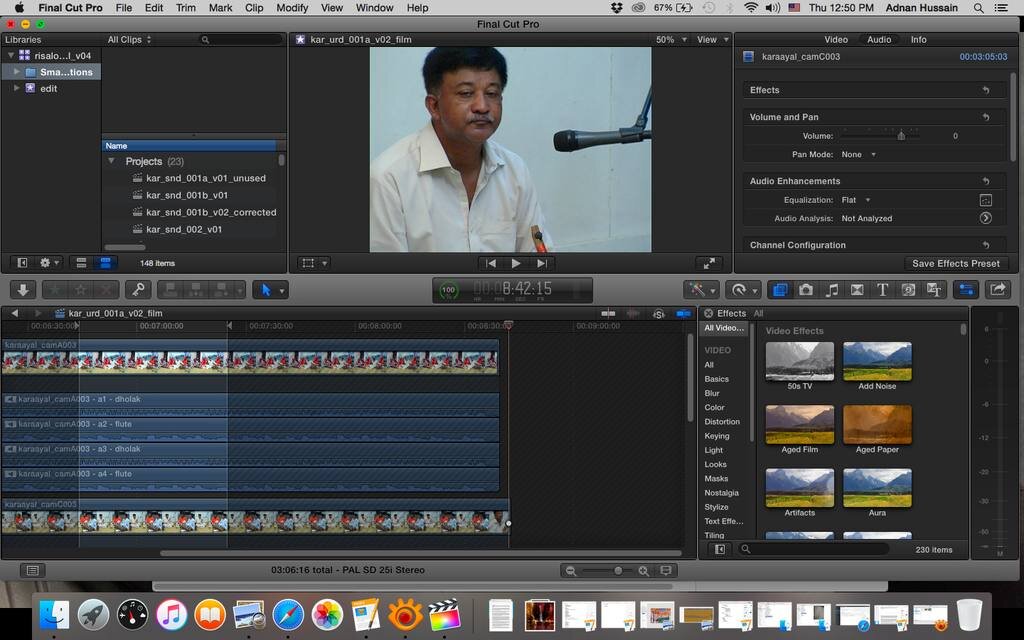
 Once I started, I just kept going, working on editing footage from the music recording sessions that I had managed to digitize before leaving Jamshoro. I started mixing tracks I had organized previously, starting with the dholak (percussion) tracks and working my way up to vocals, then adding just a touch of harmonium to sit under the vocals. It is interesting to bring out a subtle instrument and fit it just between other elements and listen to how the whole piece comes to life.
Latest Posts
- animals
- animation short film concept art
- california
- china
- condo
- costa rica
- culver city
- dance
- dance performance
- data darbar
- desert
- downtown
- festival
- figure drawing
- film festivals
- ger
- hasan abdal
- hate crime
- human rights
- humanrights palestine israel conflict activism
- India
- jamshoro
- kyrgyzstan
- la zoo
- lahore
- landscape
- landspcape
- life drawing
- live music
- live music performance watercolor sketch
- los angeles
- los angeles forest
- mogolia
- mongolia
- montezuma
- motel
- music
- music show
- musicians
- naadam
- nadam
- nankana sahib
- Orange County
- painting
- pakistan
- palestine
- panja sahib
- photo
- photography lahore pakistan travel people
- photos
- post natyam
- protest
- risalo
- sindh
- sketch
- sketches
- students
- sufi
- travel
- ucla
- USA
- uzbekistan
- uzbekistan people travel photography
- venice beach
- volunteer
- watercolor
- watercolors
- wrestling
- Yorba Linda
- zoo