
Editing music
When a singer messed up a line, they would wait for the next beat cycle and then repeat the correction. This way, I could splice out that beat cycle.

 I continued editing music, this time going deeper into splicing out mistakes in the performance. When a singer messed up a line, they would wait for the next beat cycle and then repeat the correction. This way, I could splice out that beat cycle. It seems to work well. In addition, I needed to edit down a few pieces. For the most part, I was able to get the musicians to follow some of my timing cues, but there was one singer who did not follow any timing cues and two singers who despite repeated pleadings to sing each line a single time, could not manage to do so after several takes and so I had to just record the way they sang.Checking over one particularly beautiful piece of music, I noticed that two lines had been skipped. It had been sang out of sequence and with much repetition and was in Sindhi, so try as I did while they sang, I got completely lost in the script as I was following along. There’s nothing I can do about that. Thankfully it is a very beautiful piece, and people sing these verses in that manner too, so it should be all right. The other challenge is that I need to really edit the pieces for that section of the film down as much as possible. With all the repetition of verses, I can get beautiful pieces for music albums, but some of these scenes would suffer a great deal if they were stretched out so long.This takes a lot of meticulous care to find the right spots to cut and splice sections together and check if it all flows well together. On top of that, once I get the Sindhi version to a particular length, I have to get the Urdu version matched to that. Sometimes that means cutting out an introduction or taking out 25 seconds of instruments playing. It’s all a big experiment as I come up with the workflow for getting pieces to work as I go. Things seem to work pretty effectively thanks to editing on the sum or end of the beat cycle.

In the mix
Once I started, I just kept going, working on editing footage from the music recording sessions that I had managed to digitize before leaving Jamshoro.
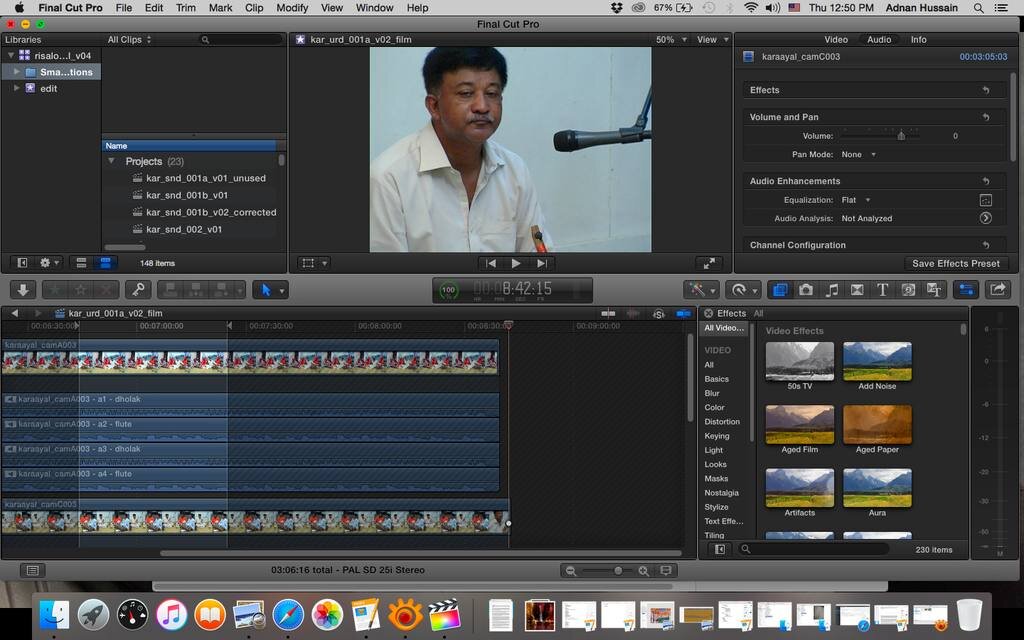
 Once I started, I just kept going, working on editing footage from the music recording sessions that I had managed to digitize before leaving Jamshoro. I started mixing tracks I had organized previously, starting with the dholak (percussion) tracks and working my way up to vocals, then adding just a touch of harmonium to sit under the vocals. It is interesting to bring out a subtle instrument and fit it just between other elements and listen to how the whole piece comes to life.

Last day of music recording?
After getting to the top floor, we sat down for a bit as the recording room was being cleaned, then went inside and began setting up with Zulfiqar sahib and Afzal sahib. One of our singers for the day, Rashid Haideri arrived. I setup my camera and recorded short introductions for both musicians. A short while later, Ustad Anb Jogi and Shahid Amjad sahib, the sitar player arrived.


I woke up, got ready, then head out with Nisar sahib to get some breakfast at a dingy little dhaba. We got back and I grabbed my gear then walked over to Sindhology. As I walked through the gates, I saw Aarab sahib, the dambura player I had requested Ustad Anb Jogi to include in today’s recording session. I had seen him perform at the Sewan mela and then talked to him at Radio Pakistan a few days later. He is a humble musician. At over 80 years of age, he has played with all the greats of yesterday and today in Sindhi music.He loves to perform and is always such a humble and kind presence. I saw him sitting by the canteen, bright and early around 8:30am as I arrived. I walked over to him and sat down. He remembered me from the radio station. He asked if I worked at Sindhology and I mentioned that I was doing the recording sessions today and had especially requested him. Sitting with him certainly had a calming effect on me.We chat for a while, then I picked up some water bottles and head up into the building with him. As we walked up the stairs, he named practically every legendary Sindhi musician whose photo lines the stairs in the museum. He was not reading the names, as there were perhaps 2 or 3 that he did not recall. He had played with almost all of them. I knew that I was the one privileged to have him in this recording session that day.After getting to the top floor, we sat down for a bit as the recording room was being cleaned, then went inside and began setting up with Zulfiqar sahib and Afzal sahib. One of our singers for the day, Rashid Haideri arrived. I setup my camera and recorded short introductions for both musicians. A short while later, Ustad Anb Jogi and Shahid Amjad sahib, the sitar player arrived.That was enough for us to record the first half of what we needed to finish that day, and by about 10am we started. We rerecorded Sur Kalyan and Sur Yaman Kalyan. This is the first scene of Risalo. It was important to get it right. As we were well into the piece, our other singer, Farzana Bahar arrived with the musicians for her portion. This was perfect. Things moved along and we continued with her. She was there to wrap up Sur Sohni, which she sang beautifully. Basically, we recorded music for the very beginning and end of the film. Having Araab sahib, the dambura player there allowed us to connect both parts musically.This happenstance was the result of many delays and problems prior to this, and yet it somehow worked out. We took a short break and said goodbye to most of our musicians. We had two hours left and I was amazed at how things had actually worked out that day. There had been a few short power outages, but musicians got there on time, and things were working. We actually finished the script which was a huge milestone. That left us time to record some fantastic solo sitar pieces with Shahid Amjad. He had practiced and planned out a few pieces the night before. It was amazing. I was free to just sit back and enjoy the performance. Everyone in the room was entranced. I am very excited about putting all of this music together over time.We had some lunch after the session, then I head back to Darya Khan’s place where I was staying. Saqib as always took lots of great photos during the session and was there to help in every way possible. I felt so relieved. I could leave Jamshoro at last and stop thinking about the project for a few days. I was well past exhaustion with the work, but extremely thankful for how well things had turned out despite endless challenges.I made calls and plans to visit friends to say thanks before I left and to return borrowed things. Many times when I have been working like crazy to finish something, there is a lot of excitement and some feeling of not knowing what to do all of a sudden when it is done. I didn’t feel that this time. Things had been so extremely difficult that I was glad to clear my mind and not think about doing anything.Several friends dropped by to visit and then I dropped in to see a few that were headed to another friend’s wedding. After that, Saqib and I head over to see Mehboob Ali Shah sahib, the wonderful sufi friend who had shared so much wisdom with me in our many visits together. We went to his bhaituk and waited with several people. He came out and it was really sweet to see him. For my benefit, he spoke in Urdu. He congratulated me on finishing the music and asked about what I was doing next. I shared my plans and then as always he shared some precious thoughts and wisdom through storytelling. He is a master storyteller.He talked about the importance of Haq or truth and how it was more valuable and rewarding than any type of monetary achievements. Though one may suffer a great deal for it, truth was the ideal to strive for above all else. I thanked him for his time, wisdom and encouragement in what had been a very challenging process for me in Jamshoro. I felt utterly humbled when he thanked me for coming to visit and for sharing. Honestly, it is such a deep feeling of love and gratitude, like a cup endlessly overflowing with water that I can’t even put into words. Here is a fantastic human being to whom countless people come to hear the wisdom he shares on Shah Latif’s poetry and his father’s. Yet he takes such an interest in everyone and has now qualms in learning from everyone around him.As always, his words of encouragement and praise and appreciation for my efforts had me bowing my head and just blinking and murmuring thanks. His words have a way of lifting you up as only someone who genuinely cares can do. It did wonders to strengthen my resolve to continue with the next phase of “Risalo". I always leave there with riches beyond my expectations, from the humility and grace of a man who embodies the beauty of Shah Latif’s poetry and message.Saqib and I hung out for a bit at my room, before he head out and I fell asleep.

Recording a second Jogi Album
One thing I did not have to worry about for this session was the script. Today’s session was just to support a few groups of musicians to create music albums, rather than record for “Risalo”.


Recording days are always busy. There is a lot of preparation and much to handle throughout the day. Logistically, I always hope that people will get there on time, and that we can be productive during a stressfully short time frame available at Sindhology. There is also the danger of people making things more difficult with petty factions and groups within the institution. Besides that, the electricity could go, or old equipment could give out. All of this nonsense makes for a very difficult time recording.One thing I did not have to worry about for this session was the script. Today’s session was just to support a few groups of musicians to create music albums, rather than record for “Risalo”. There was a group of Jogis with whom I had worked before, a few marwari singers and assorted instrument players. We wanted to record albums for both groups and a solo album on dholak with Ustad Anb Jogi. It was an ambitious amount of recording to do, but since people were performing what they already knew, it was not impossible.We started by recording a few solo pieces. Somehow things invariably take longer than expected. Though we were unable to record material for 3 albums, we did get 2 albums worth. The musicians really have no idea how much work I am going to put into this in order for them to, I hope, receive more money from sales. Perhaps if they did, they would not apply so much stress and pressure during the process. Each is being paid more than most tv channels around here pay. I’m doing my best, but there is a general attitude here that people push for extra money as hard as possible, without being able to have empathy for those they are working with. I try and explain the ground realities and risks that I am taking, and what it means to my own future to make these sacrifices now. It does not matter.These are not bad people, but everyone is still responsible for how they respond during given circumstances. It makes me less excited to push myself so hard to put together the music and promote them, yet they too are a product of their society. If anything, they are being crushed at the lower end, but unlike many have, worked to develop skills that are unique and beautiful. At some point, my efforts become more about trying to do my small part to build a better future that keeps this culture alive. If things can get better, perhaps people’s mindsets can change a bit.We shared a nice meal at a dhaba down the road, thanks to Darya Khan’s suggestion and transportation help.

Recording Sur Sorath
I took all my gear and head to Sindhology. After setup we waited. I hoped that the electricity would not go. We were recording sur Sorath, the longest piece of music in “Risalo”.


I took all my gear and head to Sindhology. After setup we waited. I hoped that the electricity would not go. We were recording sur Sorath, the longest piece of music in “Risalo”. Hasan Mohammad, the Surando player was coming from far away with his Banjo player as was Abdur Rahman Abroe, who would once again sing the Urdu verses. The surando is increasingly becoming a rare instrument. Master musicians like Hasan Mohammad are rare and this much loved instrument is at risk of vanishing.It does not take that much to support these musicians. If only the organizations, receiving government funding in Sindh allocated the designated funds to benefit them. If only the Sindhi tv channels created programming that gained a wide enough audience on the merits of their quality to pull in advertising money, rather than making musicians pay to have their music aired. If only the general public placed any kind of importance on their cultural heritage in monetary terms. I’m doing what I can, but I am not an organization.The recording session went really well. It was more difficult to judge how the bits we recorded would come together, but I feel like there were many special things about today. The mere presence of the surando brought a lot of excitement to everyone in the room. It is an all too rare and cherished treat to listen to this beautiful instrument these days.Today, I was even able to get overtime which helped us finish this long piece of music in a day. That was a huge win. Though I was exhausted at the end of the session and a bit unsure of how all of it would come together for the film, this was a much needed bit of success.After the session, we all had a meal together at a local dhaba. It was such an effort and stress to get to this point, that my feeling after recording was more of just exhaustion than even joy. Thanks as always to by friend Saqib Syd for the session photos and for just being there to help.

Recording Sur Karaayal with Jamaluddin Faqir
Recording Sur Karaayal with Jamaluddin Faqir


(photos thanks to Saqib Syed)In the morning, I was up, writing a few more notes on the script so that I could give proper story based guidance for the emotions of each scene. That would reflect in the way it was sung and the way the instruments were played.One huge relief was that Saqib had kindly agreed to take my camera and photograph. Not only that, but he would go get some fresh bread and additional food to add to what we picked up the previous night. I know that directing the musicians is an all consuming task, and I am not even completely directing them. Ustad Anb Jogi is the one getting the group in gear musically. My job would be to closely follow the script as they sang, give story cues and make sure we recorded what I needed.Anb was supposed to come by at 9am. I was ready then called him. They were just waking up. I had his dholak. I told him to meet me there. I ate breakfast, as I had not been able to eat the night before. I just could not get myself to eat. I picked up my gear and his, then walked the fifteen minutes of sweat dripping heat to Sindhology to get things prepared. I met with Zulfikar Ali Gopang sahib, the audio engineer and friend I have worked with in the past. I sat down and expressed a number of my frustrations. We had a good conversation about it and it did make me feel somewhat better. He has recorded many musicians and knows most of them that way, so he has dealt with a lot of challenges.Jamaluddin Faqir sahib and his group arrived an hour early as they had planned to stop in to see Mehboob Ali Shah sahib, but he was out of the city, so they came straight to Sindhology. They brought in their gear as the audio folks were setting up. I went down to take care of the official paperwork and fees for use of the recording facilities. Saeed Mangi sahib helped me take care of all of that in proper fashion. It took a bit of time, then I grabbed some water bottles and was heading back when Saqib showed up. I had asked him to come by at 11am and not sooner, to not waste his time.I handed off the camera to him, setup my laptop and started working with Ustad Anb Jogi on the logistics of how we could most efficiently get the takes we needed. It was hours of intense concentration on my part, but also on the part of each musician, audio engineer and photographer in the room. Jamaluddin sahib had hand written the whole Sindhi script for Sur Karayal out in his notebook, which I thought was fantastic. Similarly, Abdur Rahman Abroe had written the entire Urdu Sur Karayal in Sindhi letters, so that he could more easily read it. I was much relieved by their preparations.I had divided up the script into more manageable chunks, where we could stop at major emotional shifts or convenient spots in the story. This would make it easier to tackle several pieces that I would have to edit together later. We worked on my short film Gul in the same way years ago and that seemed to work well.At the beginning of each section, I came closer to the singers and we double checked the starting and ending verses. Then we briefly talked about the basic feel of that scene, which Anb translated musically. Anb had on the spot changed the raag they were working in as they had chosen raag Sohni and we did not want two sections with the same raag. These are things that I would be helpless at trying to change without Ustad Anb Jogi and without the musical skill of everyone present in that room.After a Sindhi section was sung once or twice, Jamaluddin sahib stepped out for a moment and Abdur Rahman Abroe took his spot and tried to do something that worked similarly in Urdu. That is not an easy task, and he really stepped up to this at the last minute when we called him. Urdu is not his first language. He is far more comfortable with SIndhi, but he worked hard and consulted someone near him regarding the Urdu script, so there were only a few spots where we needed to help him, which is perfectly reasonable.There was a good bit of back and forth regarding what I needed, what they felt would be best musically and then trying to get each section in Sindhi and Urdu to be close in length. That is a big challenge and my job editing then mixing the music will be very challenging. It was a grueling process. It was hot and each of us was dripping sweat in the studio. At one point besides the water some angel sent us a crate of cold sodas. We took a few breaks here and there, but I was also under the gun to somehow get everything done within a reasonable time round about closing time for Sindhology, which is unfortunately around 2pm. I felt a lot of pressure balancing each of those things, but that is the nature of the work.The musicians did a fantastic job and I made sure they were well appreciated throughout. How else can you get through all these challenges? Thanks to all the help, I think we managed to balance things out well. Everyone seemed happy and no one seemed to be driven to frustration. We finished the work on time, then head downstairs for a few short video introductions for each musician. After that, we head to the hostel mess for some food.I was exhausted and so was everyone else. Saqib went to get fresh bread and some more food. I went in the kitchen and started heating up the food I picked up the night before. The room with the dishes and microwave was locked. It turned out the person with the key was away and unreachable. The one thing I had asked for was dishes. Another obstacle. I looked all over the kitchen and grabbed any plate, bowl container I could find. The burners are always on, so I washed all these random containers then heated up food.Daulat of the mess staff chipped in to help. Then Ustad Anb Jogi dropped in the kitchen to see how things were and jumped in to help heat up bread. Eventually a few more members of the mess staff helped us out and bit by bit we served up some hot food for everyone. We had only one glass, so I grabbed whatever glasses and dishes I had in the room, washed and served those. I had a bag of mangoes, so I cut those up and shared too. I think it all worked out well. Saqib came by with resupplies of bread and food. We managed to feed everyone properly, said our thank yous and goodbyes then head our separate ways.Saqib hung around to help me out and hang out a bit after before we head our separate ways to get some rest. I was glad he had a good time and was absolutely invaluable to making the day possible. Now to prepare for tomorrow, and get some rest. I hope we can somehow get through the longer piece in time. We are starting two hours earlier, so let’s see what we can do.I lay around for a few hours. Sleep did not come to me, but I felt better. At night Saqib came by and we chatted for a while. After he head home, I saw Zulfikar Ali Gopang sahib had called. I called him back and learned that a staff member at Sindhology had died of heat stroke so everyone there was going to the funeral. There have been a great deal of deaths all over Sindh due to this heat wave, a lack of electricity and water for many. I have heard numbers as high as 1,000 deaths across Sindh due to heat stroke. As difficult as my room can be due to heat, I’m not laboring out in the sun, or living on the sidewalk.I called Ustad Anb Jogi to inform all the musicians that the session was cancelled. I felt sad for the family of the man who died. We’ll reschedule the recording when the musicians are back in town after some performances they have.

Where to now? Lahooti and the Sketches
Where to now? Lahooti and the Sketches

I felt a bit better after some rest, but knew I needed to take it easy. I was waiting on word of some puppeteers in Umerkot. They are wanderers, who head out on “sair” without any way of contacting them. This is their way. They could come back in a few days or a couple of weeks. Thankfully, friends are there to check in and can send me photos when they return.I don’t feel like I can wait around here though. While I had done many interesting things during this last month, I have not been able to reach any possible puppeteer collaborators yet. I feel it is time to go to Punjab and investigate the state of puppetry there. I have spoken to one puppeteer on the phone who lives in Multan, and have researched several who are on that side of the country. Now it is matter of obtaining their contact info and meeting them to get to know their work and personalities. It is a very disheartening process. So many people are helping me, and yet, it is still a huge undertaking to try and find something that has all but vanished and then hope that it is in a state that can be salvaged.Since I was in Jamshoro again, I took care of a few things that needed to be done. Met up with Zulfikar Ali Gopang, who was the recording engineer who did such a fantastic job on “Gul” and the Girnari Jogi Group album. It was great to catch up and I really appreciate the willingness to do something positive for these musicians who are the living embodiment of our cultural heritage.


I contacted Saif Samejo of the band the Sketches and Lahooti which are two fantastic projects that I have been following for a while. Samina Panwhar had connected us via facebook a few days ago and Umair Jaffer had mentioned that I should talk to him before my trip as well. He called me back and sent his car to pick me up as he is in Jamshoro, but a but inside of a residential area, which would have been difficult for me to get to. It was really great to connect and learn more about his work. I have already been a fan of the work he is doing, but to meet him and share a bit of my efforts as well was really great. He is creating a beautiful space for music and creativity. I look forward to seeing his future projects.I took it easy that night. Hisam let me crash at his faculty dorm. I got some much needed rest.

Wandering with Jogis
I had come to SIndh, Pakistan from Los Angeles seeking a group of wandering snake charmers; Jogis to add their music to my animated film "Gul". Little did I know how connected we would be in the years to come, from devastating floods to bringing Sufi poetry to the world all thanks to people joining together to do some good.


Six years ago, I found myself at the side of a freeway eating food under a rickety hut in the deserts of Jamshoro, Sindh in Pakistan. The air was hot, as was the food. Drenched in sweat, I looked out past the asphalt, across sand, sprinkled in defiant bits of green. I had come there from Los Angeles seeking a group of wandering snake charmers; Jogis to add their music to my animated film "Gul". Little did I know how connected we would be in the years to come, from devastating floods to bringing Sufi poetry to the world all thanks to people joining together to do some good.

Thanks to help from Suffi Bilal Khalid, Fatah Daudpoto, Saeed Mangi and others who made my work possible, I have a story to share. I went to pick up Ustad Amb Jogi and Jairam Jogi at the Hyderabad rail station in Sindh. We would have ridden in two auto rickshaws, but they humbly suggested that one was enough. We piled in with my friend Azam Bugti, the two musicians, their large instrument cases and the auto driver, then went to Fatah sahib's apartment. In the apartment, we met a few more local musicians, and each played a bit. I was mesmerized. It took years of grueling effort to get to this point. The musicians asked what I was looking for and I played a few recordings. They had never made music for films before. I reassured them, that what I wanted was their music, expressing the emotions of my film. After setting a date for a recording session and overcoming some other logistical challenges, I found myself with them again at the recording studio at the Institute of Sindhology in Jamshoro.
 With hand gestures and words, I gave them cues for timing as Ustad Amb Jogi lead them through different raags and emotional arcs of the film. Each musician added their embellishments and created a rich piece of music. I was ecstatic. All that pressure and effort came down to several hours of weaving music from their seventh and eighth generation traditions, into a nine minute piece of music. We shared a meal after the recording session, then bid farewell. I came back to Los Angeles, with the recordings which I mixed and edited. I finished the rest of my film and "Gul" was born.The Jogis came with me through their music to festivals around the world. My film had no words, but the emotions of their music and sound design by my friend Brian Stroner. I put together a section devoted to them on my website, to let the world know them. The following year, I returned to Sindh, to give thanks to friends and share the finished film. The Jogis met in the lawn of a local radio station. I was overjoyed to see them again. They told me that it was not a particularly large project that we had worked on, but when I called them about meeting, they came because they appreciated my respect for them. I felt the same way. We sat and talked for a while. I told them how people around the world loved their music at festivals I went to. I gave them DVDs for each member of the group. I learned more about the challenges they face as musicians, such as never receiving copies of their recordings, never being showcased in their own album, and certainly not receiving the financial rewards for their art that they should. They were known as being among the best at each of their instruments, yet being illiterate and of simple means, promotion was not something they could manage. Yet these were not complaints. They shared with me, only after some pushing, out of a sense of trust.My project was funded out of pocket. They sat with me and gave it all the care and skill they had. In turn, I tried to give them the utmost respect as fellow artists as well as paying them for their hard work. These are sweet, humble people. I wanted to do more. I asked them to get recordings of their work, and have them sent via a friend at the University to me in Los Angeles, that I might cobble something together to promote them further. They agreed and we parted ways.I came back to Los Angeles, after that summer and got busy in trying to earn a living again to keep bills paid. I called Ustad Amb Jogi in November the next year, only to learn that he and the rest of the Jogis had lost their homes to devastating floods. Ashamed that I had not thought to check in sooner, I began to think about what I could do. I took video from our recording session and put it together. Based on that, I created a small campaign selling that one piece of music and sharing their story. It took a few months of personally emailing, calling and speaking to as many people as possible, but we raised $1,200 which I transferred to Ustad Amb Jogi. My friends at Sindhology came through to support once again. They provided recording services, then sent me the footage to edit and mix with funds going to the musicians and minimal recording costs.

Out of that project came a DVD and CD of the Jogis, with their names on it, short bios, photos and introductions with subtitles as a fledgling vehicle to promote and support their livelihoods. I told everyone about the project, shared the Jogi's story and music online for free and in person everywhere I went. People bought the album and at a very grass roots level it has been able to help the Jogis by raising more funds. Their videos have received thousands of views online, and where once there was no trace of them to the outside world, now people from every corner of the world can know them and their music in their own words. This project did not take millions of dollars to create. It took care, trust and a lot of love. They gave me what I could never create, and I in turn applied my skills and resources to try and share what I could. In the end, I feel empowered by what can happen with an idea and the many people who help to make it a reality. At the moment, I am planning a new project with the Jogis, assorted other musicians and puppeteers, to dig deeper and share more of the rich culture there as well as benefit more artists. We are creating a traditional puppetry film based on sufi poetry by Shah Abdul Latif Bhitai which will bring together Sindhi folk musicians and Rajasthani puppeteers in the form of a film that crosses a border that has kept families apart for almost 70 years. Once again, it started with an idea, and is steadily growing, thanks to the power of people coming together to try and do some good.Learn more about the puppet film; "Risalo".

Kaya Press' Mehfil Massive at USC
Kaya Press' Mehfil Massive at USC

Here are some sketches I made during the performances at Kaya Press' Mehfil Massive event at USC. Organized by Neelanjana Banerjee, with D'Lo as the host who presented DJ Bandish Projekt, Amarnath Ravva, Salman Ahmad of Junoon, Kazim Ali, Brooklyn Shanti, Robin Sukhadia aka Tablapusher, Tarfia Faizullah, Gingger Shankar, Bhanu Kapil, Mandeep Sethi, Raginder "Violinder", Crowned Kinglsy, Jordan Palmer and Tabla Vadak.


Himalayan Festival Laguna Beach
Himalayan Festival Laguna Beach watercolor sketches

I was a vendor with rHope at the Himalayan Festival of Laguna Beach at the Pageant of the Masters. Here are a few sketches I managed, from a fun celebration of food, art, dance and music from Tibet, Bhutan, Nepal and India.


Gonzalo Bergara Quartet at the Blue Whale
Watercolor sketches of Gonzalo Bergara Quartet at the Blue Whale
Went to see some the incredible Gonzalo Bergara Quartet at the Blue Whale in downtown Los Angeles with a few friends. Here are some sketches I painted during the first half of their set.


Whalesound Intimate Sea Album Cover
The process of making album artwork for Whalesound.

My friend Azeem Khan is a talented musician, working under the name Whalesound. He came to me with a concept for his album "Intimate Sea", that I made into this album cover for him. Below you can see pencil sketches and some watercolors I did for the piece as well as the artwork on the cd itself.


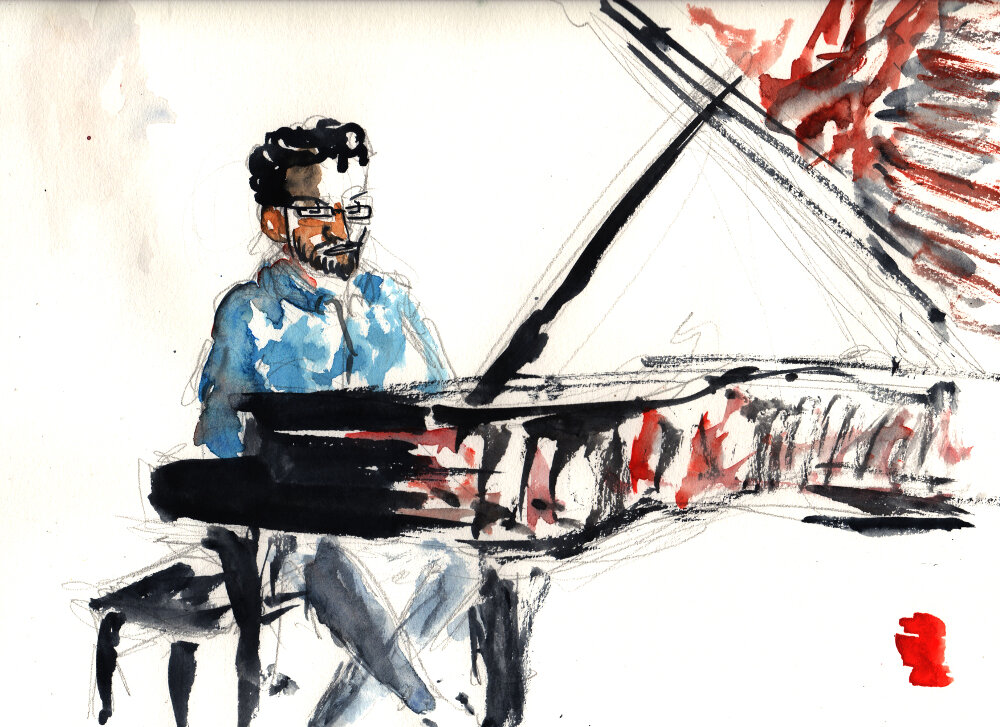
Tarek Yamani at the Blue Whale
Tarek Yamani, solo piano performance at the Blue Whale, watercolor sketches.
I went to see Tarek Yamani's solo piano performance at the Blue Whale. There's something special about being lost in music, and letting the brush flow. These are some watercolor sketches, before and during the performance.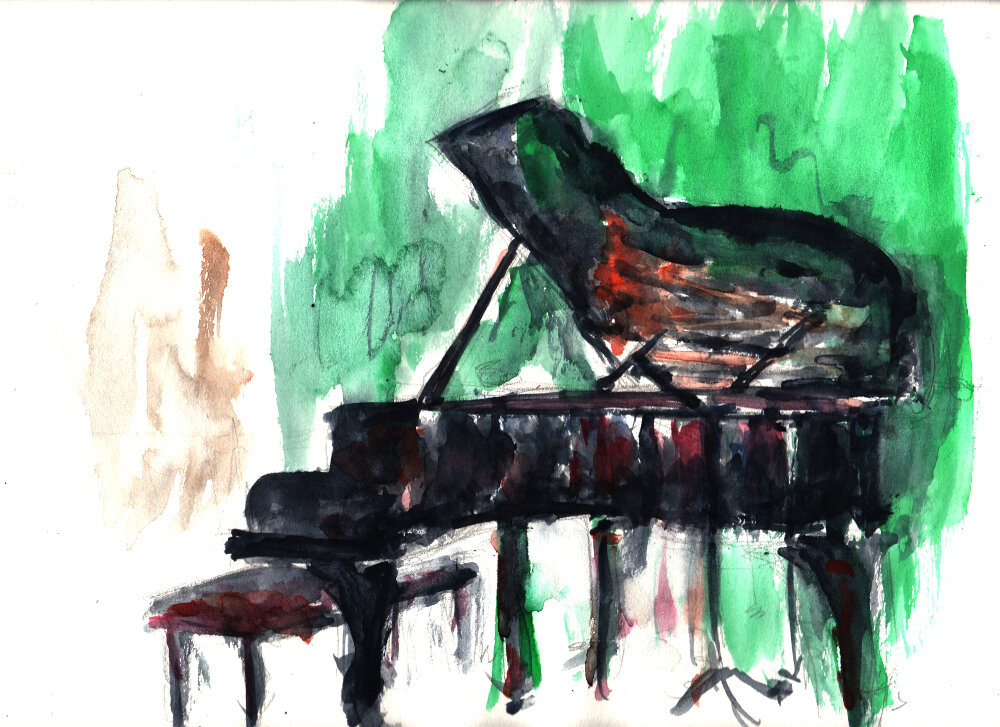

Eid Festival Anaheim 2013
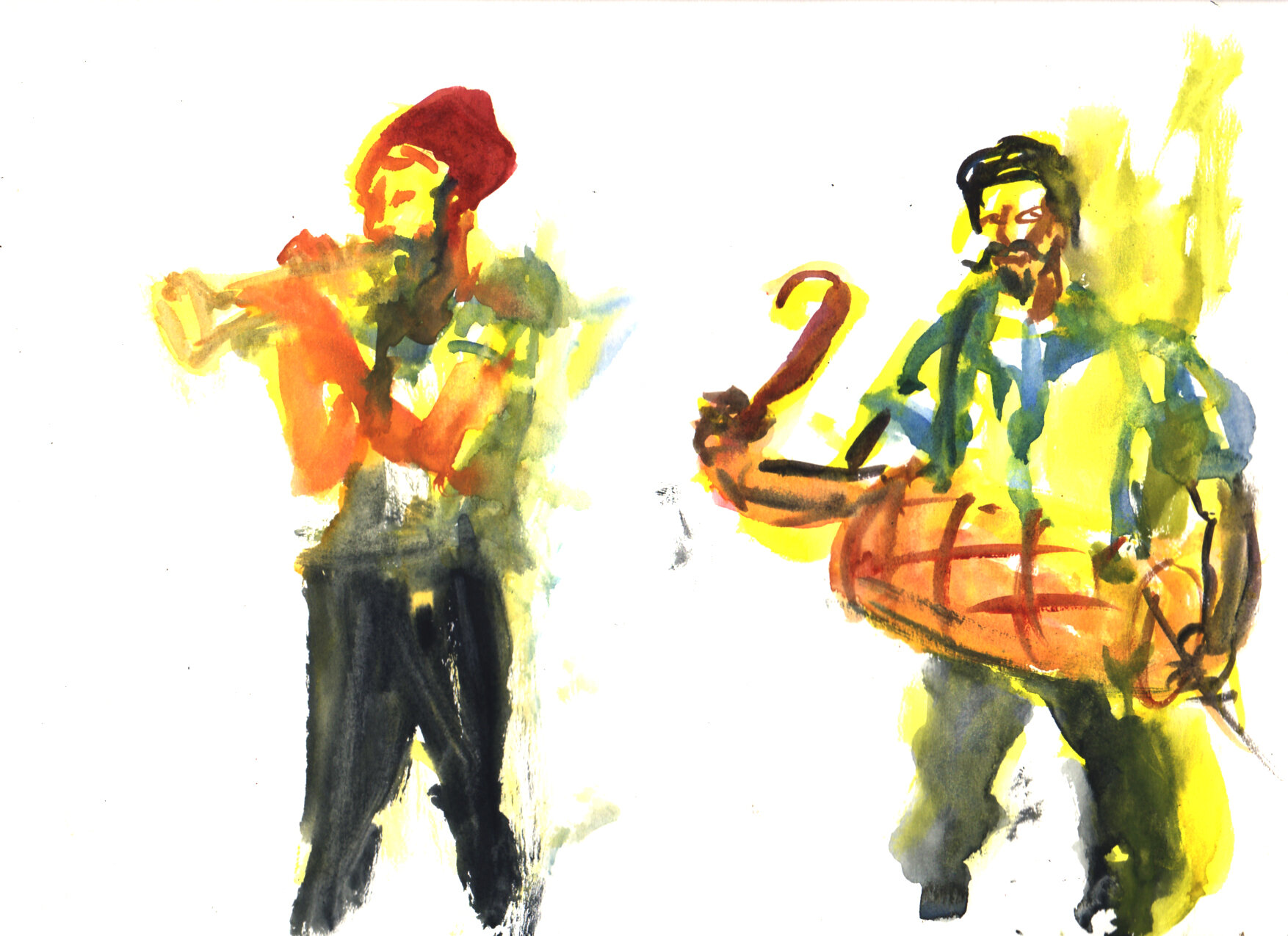
Enjoyed some food, friends, family, games and music at the Eid Festival 2013 in Anaheim.
Enjoyed some food, friends, family, games and music at the Eid Festival 2013 in Anaheim. Here's a sketch I created of a great performance by a doumbek and flute player at the show.
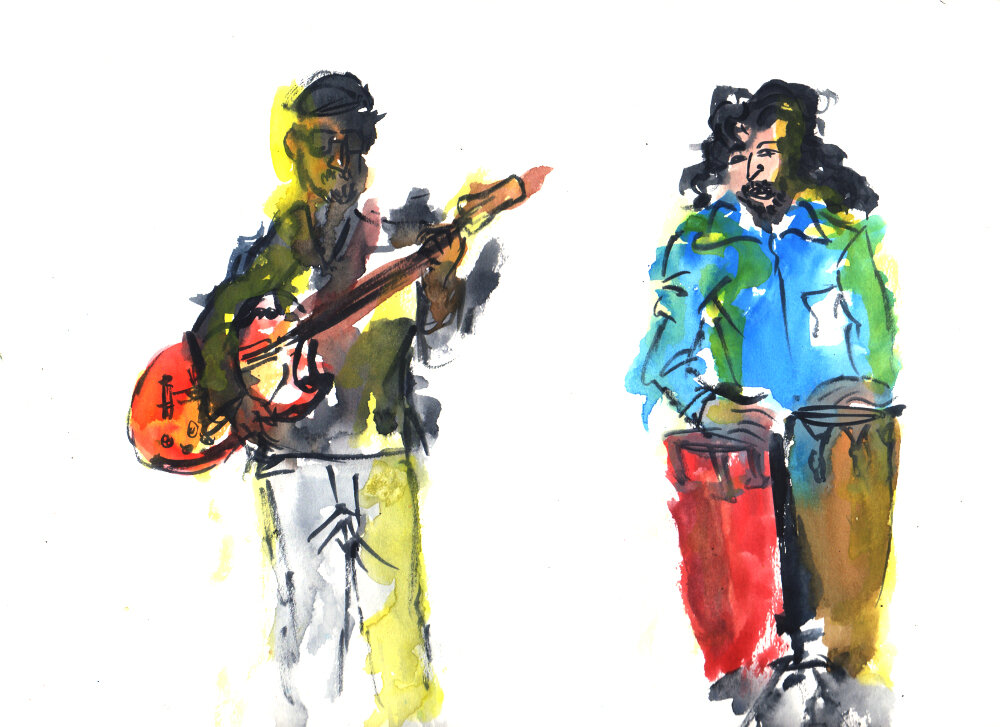
Red Baraat and La Chamba at FIGat7th Downtown Festival
Red Baraat and La Chamba at FIGat7th Downtown Festival Watercolor Sketches
Joined lots of friends for Red Baraat and La Chamba live at FIGat7th in downtown Los Angeles. What an amazing show! Here are some watercolor sketches from the performance. These ones were painted straight to paper without any pencils, which is fun. The first is of La Chamba and the second is of members of Red Baraat.
Las Cafateras at Grand Performances
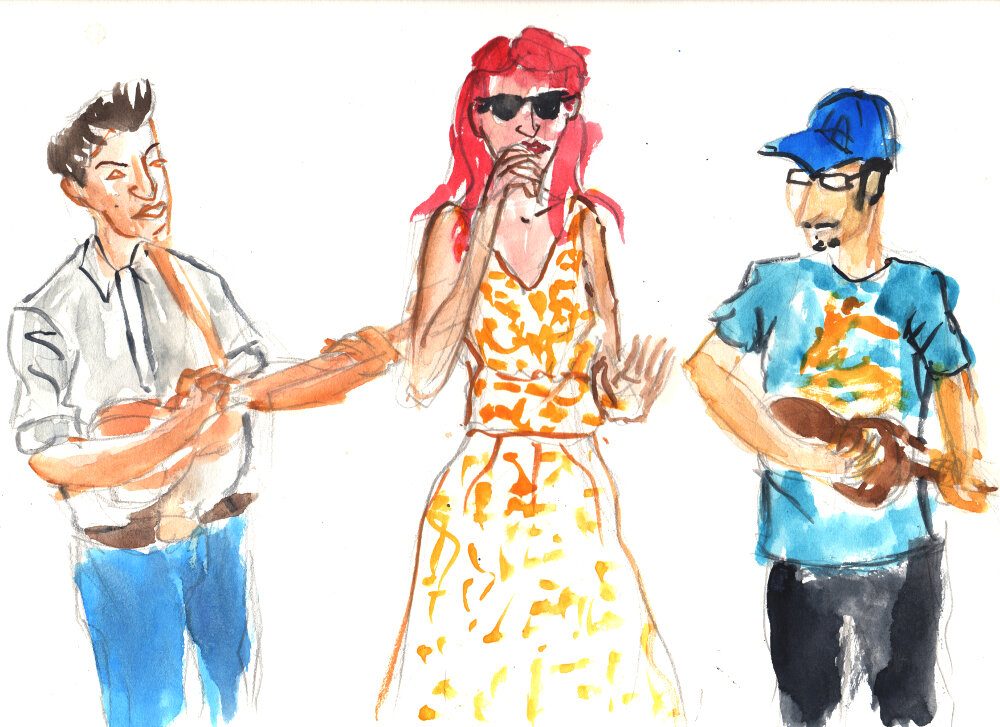
Las Cafaterias at Grand Performances
Hopped on the metro and caught a great noon show by Las Cafateras at Grand Performances. Here's a sketch I created during their performance.
Adunni and Nefertiti and Martha Redbone at Grand Performances
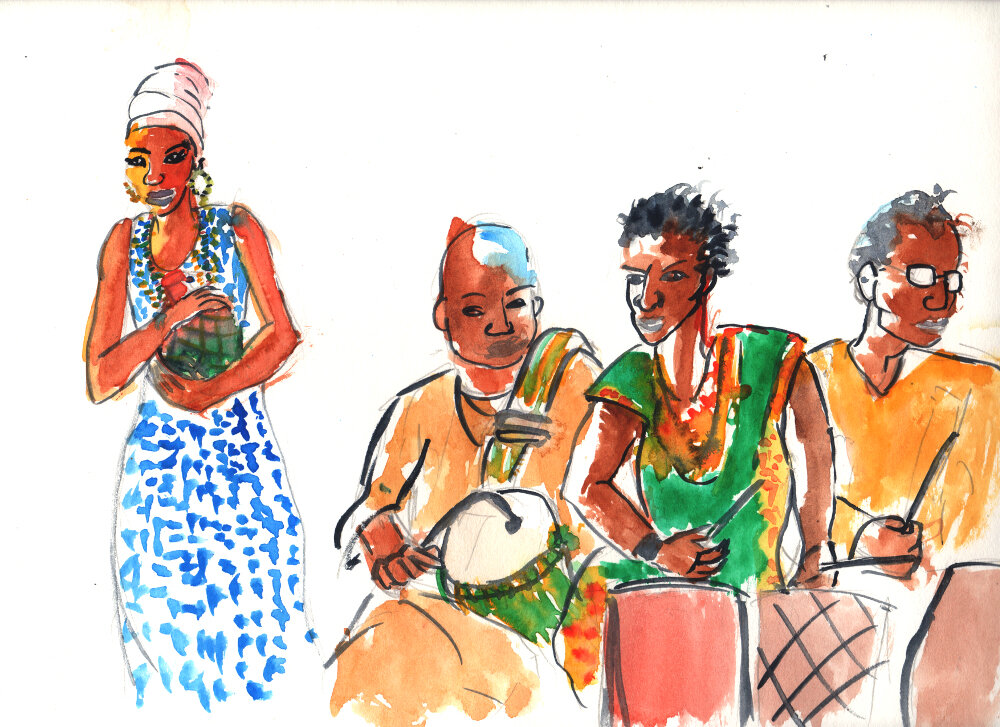
Dropped by Grand Performances to see Adunni and Neferetiti and Martha Redbone for another show and some painting on saturday.
Dropped by Grand Performances to see Adunni and Neferetiti and Martha Redbone for another show and some painting on saturday. It got a bit cold, so I only stayed through the first two acts, missing Dessy Di Lauro, but it was fantastic. Adunni and Nefertiti came out for a soundcheck about before the show, and immediately they were captivating. Their voices, merged into one along with drumming was mesmerizing. Redbone with their steel guitar, banjo, vocals etc were so full of energy and fun. Here are sketches I made at the show.
Nina Simone Tribute at Grand Performances
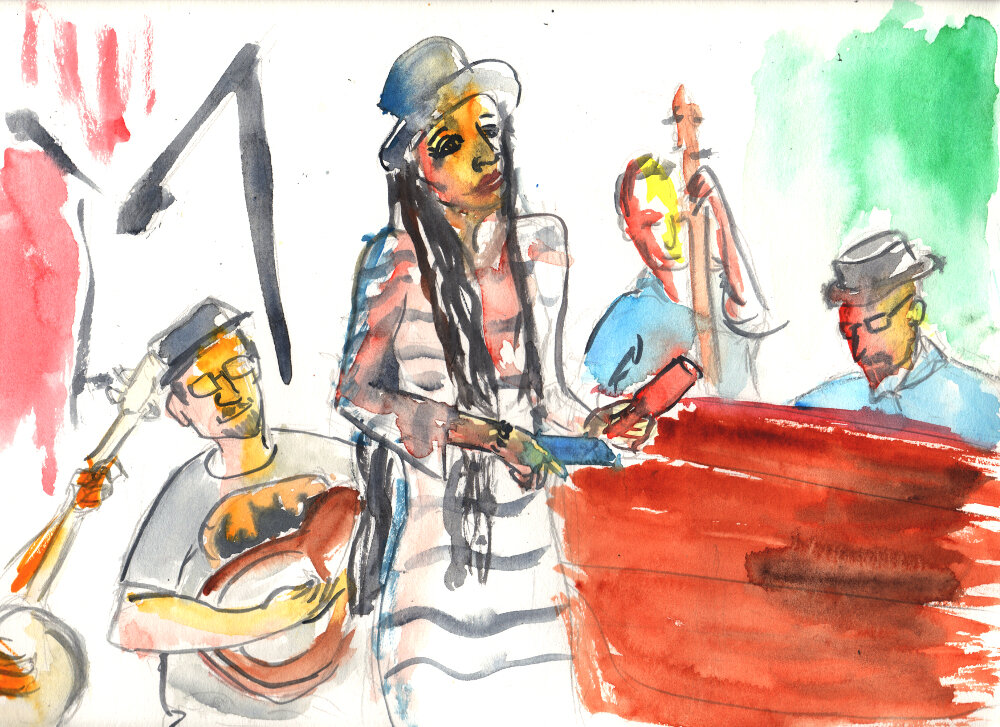
I went to a beautiful free concert at Grand Performances in tribute to Nina Simone. It was a great night of classic Nina Simone songs played by a great group of musicians.
I went to a beautiful free concert at Grand Performances in tribute to Nina Simone. It was a great night of classic Nina Simone songs played by a great group of musicians. The entire area was packed with people. My friend and I walked all around to find a good spot throughout the show, and eventually settled on standing with a view of behind the stage. It was actually a good spot, considering the place was so packed. It was an interesting way to enjoy the show. It was from there that I put this little sketch together.
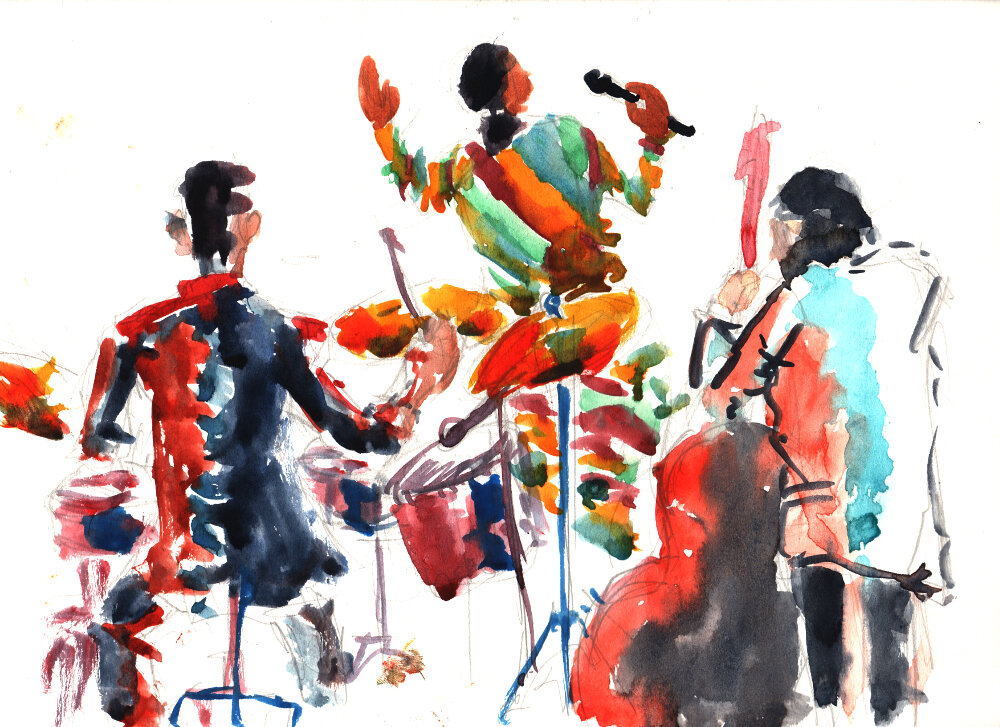
Alan Broadbent - Heart to Heart Album Cover
Two time Grammy winner, Jazz pianist and composer Alan Broadbent's new solo piano album "Heart to Heart" is out now, featuring a watercolor sketch of mine on the cover. I painted it live at the Catalina Jazz Club during a performance by the Charlie Haden Quartet.
Two time Grammy winner, Jazz pianist and composer Alan Broadbent's new solo piano album "Heart to Heart" is out now, featuring a watercolor sketch of mine on the cover. I painted it live at the Catalina Jazz Club during a performance by the Charlie Haden Quartet.
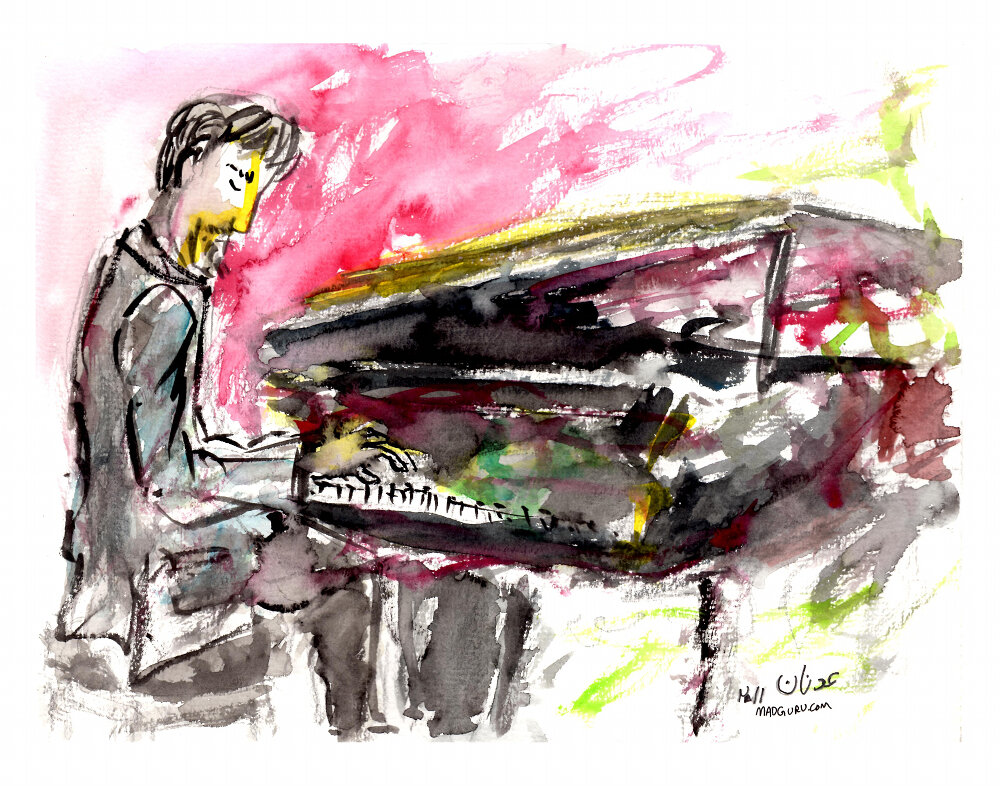
Purchase a print of the cover art - Purchase the album from Amazon - CD Baby - Google Play - iTunesThe album features these tracks played solo by Alan:1. "Hello my Lovely" by Charlie Haden2. "Heart to Heart" by Alan Broadbent3. "Alone Together" by Arthur Shwartz4. "Now and Then" by Alan Broadbent5. "Journey Home" by Alan Broadbent6. "Blue in Green" by Miles Davis and Bill Evans7. "Love is the Thing" by Alan Broadbent8. "Lonely Woman" by Ornette Coleman9. "Cherokee" by Ray NoblePurchase a print of the cover art - Purchase the album from Amazon - CD Baby - Google Play - iTunes
Elephants with Guns at the Indian Film Festival of Los Angeles 2013
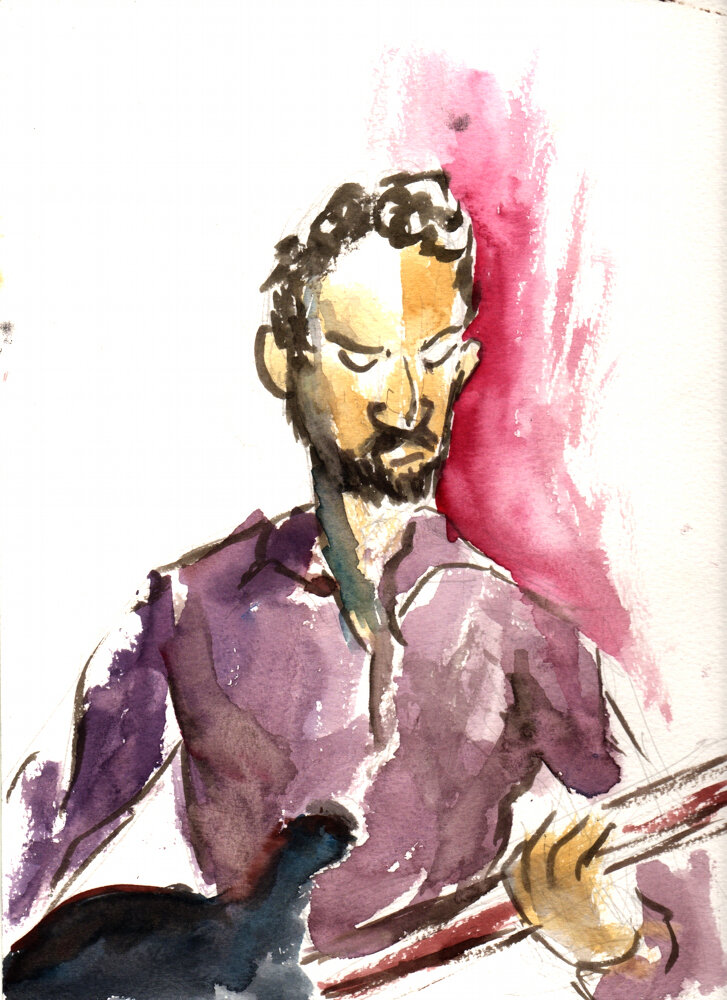
I checked out a short set with the new lineup of the band Elephants with Guns at the Indian Film Festival of Los Angeles' Rhythm Village, put on by Rukus Avenue. It was a short and powerful set. I can't wait to see a longer set by the band. I managed a few quick sketches of Jayson Joseph and Nikhil Cooper.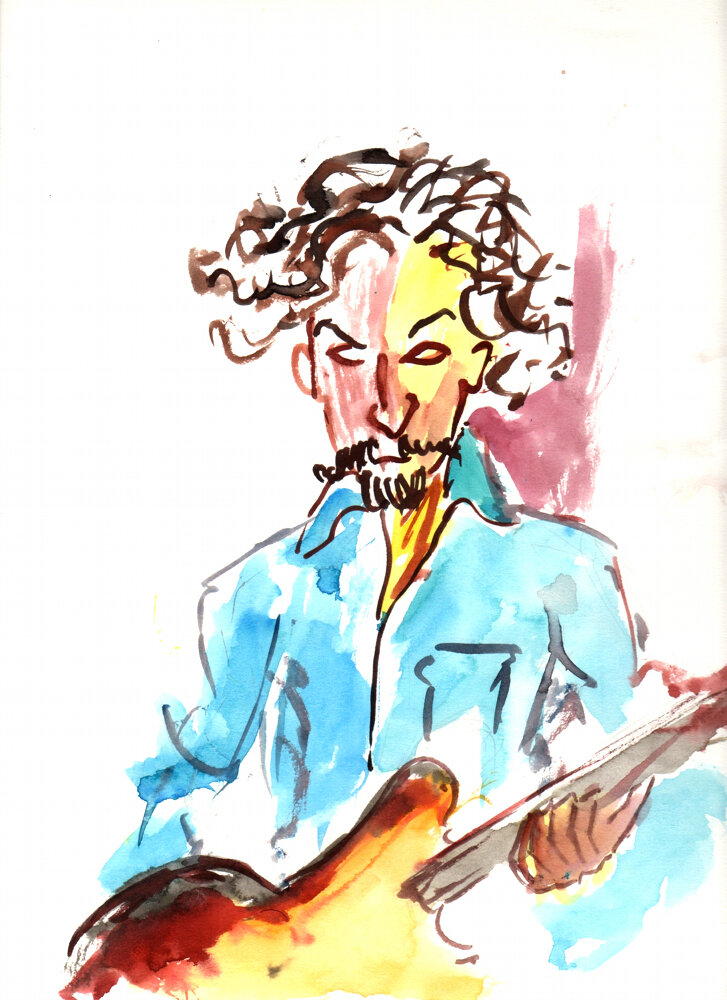
Latest Posts
- animals
- animation short film concept art
- california
- china
- condo
- costa rica
- culver city
- dance
- dance performance
- data darbar
- desert
- downtown
- festival
- figure drawing
- film festivals
- ger
- hasan abdal
- hate crime
- human rights
- humanrights palestine israel conflict activism
- India
- jamshoro
- kyrgyzstan
- la zoo
- lahore
- landscape
- landspcape
- life drawing
- live music
- live music performance watercolor sketch
- los angeles
- los angeles forest
- mogolia
- mongolia
- montezuma
- motel
- music
- music show
- musicians
- naadam
- nadam
- nankana sahib
- Orange County
- painting
- pakistan
- palestine
- panja sahib
- photo
- photography lahore pakistan travel people
- photos
- post natyam
- protest
- risalo
- sindh
- sketch
- sketches
- students
- sufi
- travel
- ucla
- USA
- uzbekistan
- uzbekistan people travel photography
- venice beach
- volunteer
- watercolor
- watercolors
- wrestling
- Yorba Linda
- zoo